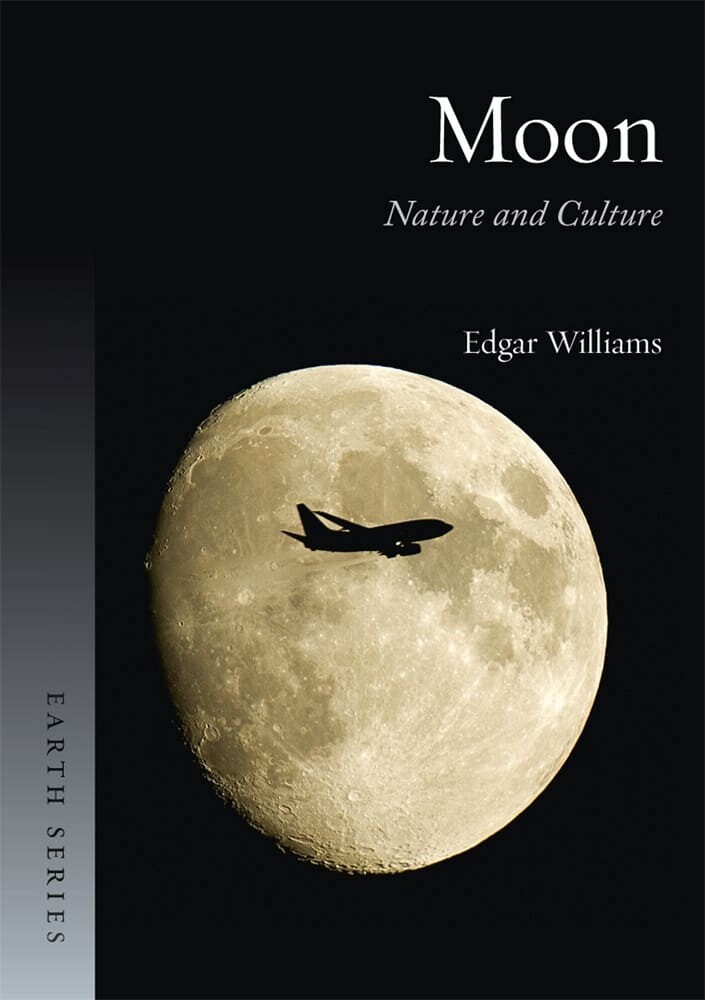
Moon
Nature and Culture
Edgar WilliamsA succinct, informative and beatifully illustrated account of the science and culture of the moon.
Since humans first gazed upward, the moon has hung in the sky virtually unchanged, entrancing generations of poets, artists and scientists. Once worshipped as a deity, often thought to cause madness, now known to manipulate our tides and much else besides, humanity’s relationship with the moon has been ever-changing; the one constant has been our continued fascination with it. Moon gives a comprehensive account of our lunar companion’s significance, tracing its origins out of a collision with Earth and following its rich cultural resonance in the worlds of literature, art, religion and politics.
The moon’s story is also humanity’s own story: it gave humans the ability to organize time, dividing the year into months and ordaining the dates of festivals such as Easter, Ramadan and the Chinese New Year. Its moderating effect on the earth’s spin could mean that without the moon life may never have been able to evolve. Edgar Williams shows how the interdependence of moon and Earth also finds its unwitting parallel in the realm of culture, where the moon has constantly found it itself embedded in our preoccupations, whether in the worship of Elizabeth I as Diana, moon goddess, or in the long-lived dream that humans will one day populate its surface.
Moon tells a succinct, witty and informative tale of everything lunar, filled with entertaining anecdotes about what the moon has meant to us. For sky-gazers everywhere, Moon is not to be missed.
A succinct, informative and beatifully illustrated account of the science and culture of the moon.
Since humans first gazed upward, the moon has hung in the sky virtually unchanged, entrancing generations of poets, artists and scientists. Once worshipped as a deity, often thought to cause madness, now known to manipulate our tides and much else besides, humanity’s relationship with the moon has been ever-changing; the one constant has been our continued fascination with it. Moon gives a comprehensive account of our lunar companion’s significance, tracing its origins out of a collision with Earth and following its rich cultural resonance in the worlds of literature, art, religion and politics.
The moon’s story is also humanity’s own story: it gave humans the ability to organize time, dividing the year into months and ordaining the dates of festivals such as Easter, Ramadan and the Chinese New Year. Its moderating effect on the earth’s spin could mean that without the moon life may never have been able to evolve. Edgar Williams shows how the interdependence of moon and Earth also finds its unwitting parallel in the realm of culture, where the moon has constantly found it itself embedded in our preoccupations, whether in the worship of Elizabeth I as Diana, moon goddess, or in the long-lived dream that humans will one day populate its surface.
Moon tells a succinct, witty and informative tale of everything lunar, filled with entertaining anecdotes about what the moon has meant to us. For sky-gazers everywhere, Moon is not to be missed.
-
'
Moon is well illustrated throughout . . . an enlightening and interesting account of the Moon and its continuing and expanding influence on mankind.
'Sky at Night Magazine
-
'
an enjoyable narrative that is well illustrated by images captured by spacecraft, drawn by astronomers, artists and designers, and depicted in science fiction movies.
'Nature Geoscience
Introduction
1. Lunar Shadows
2. Time and Motion
3. Stories and Legends
4. Man and the Moon
5. Lunar Art and Literature
6. One Small Step for a Man, One Giant Leap for Mankind
7. Legacy
Timeline for Moon Landings
References
Select Bibliography
Associations and Websites
Acknowledgements
Photo Acknowledgements
Index
Edgar Williams was Professor of Cardiopulmonary Science at the University of South Wales, conducting research in respiratory and cardiovascular physiology. He was the author of Moon: Nature and Culture (2014) in Reaktion’s Earth series.