Men In Black
John HarveyMen's clothes went black in the nineteenth century: Dickens, Ruskin and Baudelaire all asked why it was, in this age of supreme wealth and power, that men wanted to dress as if going to a funeral. For an answer one must look at the history of black.
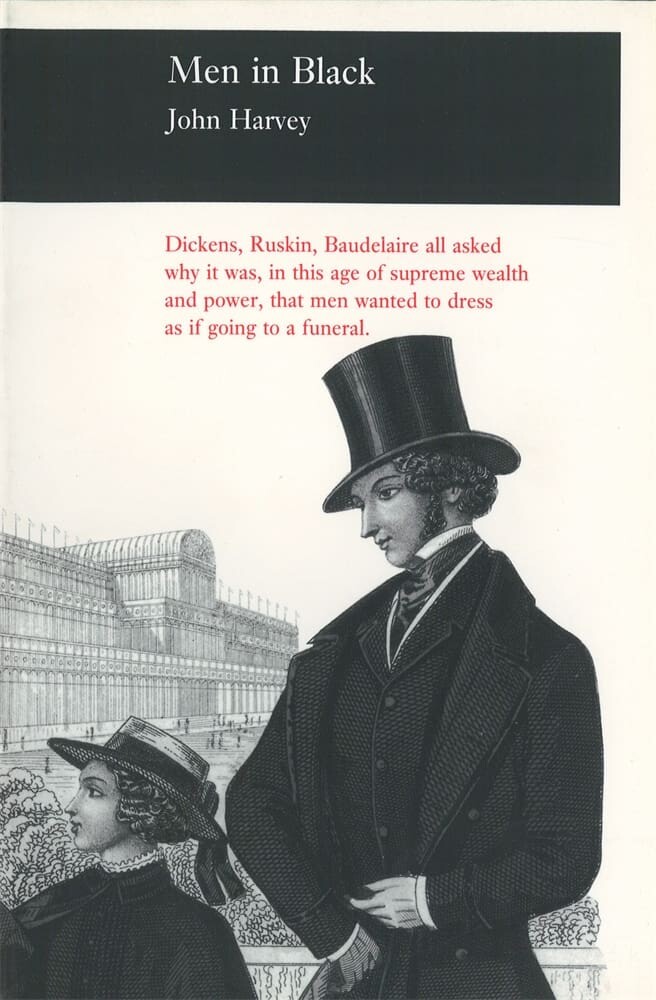
Men’s clothes went black in the nineteenth century: Dickens, Ruskin and Baudelaire all asked why it was, in this age of supreme wealth and power, that men wanted to dress as if going to a funeral. For an answer one must look at the history of black.
Over the last 1000 years there have been successive expansions in the wearing of black – from the Church to the Court, from the Court to officials and the merchant class. Though the fashion was often smart and elegant, the growth and expansion of it were fed by several dark currents in Europe’s history: politics; asceticism; and religious warfare. It was only in the nineteenth century that the black fashion fully came into its own; the most telling witnesses constantly saw connections between the taste for black and the forms of constraint with which European society regimented itself.
Although the twentieth century has aimed for new colours and a new direction, black has retained its authority as well as its associations with strength and cruelty. At the same time black is still smart, and fashion keeps returning to it. It is, perhaps, the colour that has come to acquire the greatest, most significant range of meaning in human history.
Men's clothes went black in the nineteenth century: Dickens, Ruskin and Baudelaire all asked why it was, in this age of supreme wealth and power, that men wanted to dress as if going to a funeral. For an answer one must look at the history of black.
Men’s clothes went black in the nineteenth century: Dickens, Ruskin and Baudelaire all asked why it was, in this age of supreme wealth and power, that men wanted to dress as if going to a funeral. For an answer one must look at the history of black.
Over the last 1000 years there have been successive expansions in the wearing of black – from the Church to the Court, from the Court to officials and the merchant class. Though the fashion was often smart and elegant, the growth and expansion of it were fed by several dark currents in Europe’s history: politics; asceticism; and religious warfare. It was only in the nineteenth century that the black fashion fully came into its own; the most telling witnesses constantly saw connections between the taste for black and the forms of constraint with which European society regimented itself.
Although the twentieth century has aimed for new colours and a new direction, black has retained its authority as well as its associations with strength and cruelty. At the same time black is still smart, and fashion keeps returning to it. It is, perhaps, the colour that has come to acquire the greatest, most significant range of meaning in human history.
Men's clothes went black in the nineteenth century: Dickens, Ruskin and Baudelaire all asked why it was, in this age of supreme wealth and power, that men wanted to dress as if going to a funeral. For an answer one must look at the history of black.
Men’s clothes went black in the nineteenth century: Dickens, Ruskin and Baudelaire all asked why it was, in this age of supreme wealth and power, that men wanted to dress as if going to a funeral. For an answer one must look at the history of black.
Over the last 1000 years there have been successive expansions in the wearing of black – from the Church to the Court, from the Court to officials and the merchant class. Though the fashion was often smart and elegant, the growth and expansion of it were fed by several dark currents in Europe’s history: politics; asceticism; and religious warfare. It was only in the nineteenth century that the black fashion fully came into its own; the most telling witnesses constantly saw connections between the taste for black and the forms of constraint with which European society regimented itself.
Although the twentieth century has aimed for new colours and a new direction, black has retained its authority as well as its associations with strength and cruelty. At the same time black is still smart, and fashion keeps returning to it. It is, perhaps, the colour that has come to acquire the greatest, most significant range of meaning in human history.
John Harvey is a novelist and critic. He taught for the Cambridge English Faculty from 1974, and in 2000 became University Reader in Literature and Visual Culture. He is a Life Fellow of Emmanuel College, Cambridge. He is the author of Men in Black (Reaktion, 1997) and The Story of Black (Reaktion, 2013).