


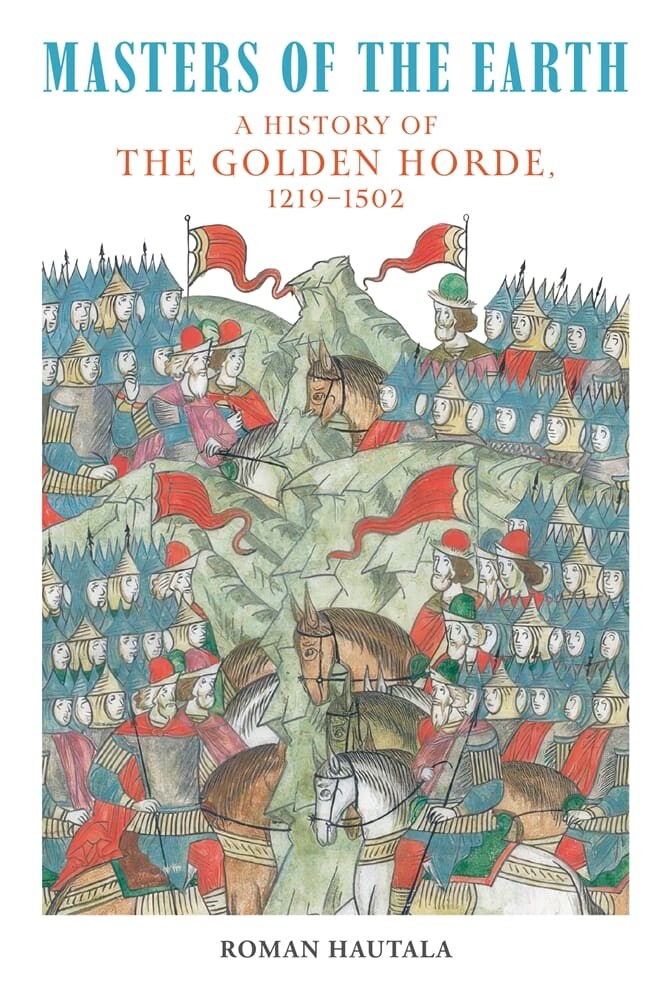
Masters of the Earth
A History of the Golden Horde, 1219–1502
Roman HautalaA revealing history of the nomadic empire that transformed Eurasia’s political world
The Golden Horde was a powerful nomadic state that shaped Eastern Europe and modern-day Kazakhstan from the thirteenth to the sixteenth century. Masters of the Earth traces its rise within the Mongol Empire, its period of independence and prosperity and its eventual decline in the face of continual civil conflict. Roman Hautala introduces the administrative and ethnic structures of the Horde, its religious policies and its wide-ranging commercial ties with both East and West. The Golden Horde emerges not only as a military force but as a dynamic society whose influence reached far beyond the steppe. Understanding this history offers a richer sense of Eurasia’s past and the connections that shaped it.
A revealing history of the nomadic empire that transformed Eurasia’s political world
The Golden Horde was a powerful nomadic state that shaped Eastern Europe and modern-day Kazakhstan from the thirteenth to the sixteenth century. Masters of the Earth traces its rise within the Mongol Empire, its period of independence and prosperity and its eventual decline in the face of continual civil conflict. Roman Hautala introduces the administrative and ethnic structures of the Horde, its religious policies and its wide-ranging commercial ties with both East and West. The Golden Horde emerges not only as a military force but as a dynamic society whose influence reached far beyond the steppe. Understanding this history offers a richer sense of Eurasia’s past and the connections that shaped it.
-
'
An essential work for the study of the Mongol Empire and for Eastern Europe. Roman Hautala does a masterful job of untangling the complicated knots of the history of the Golden Horde and then weaves it into an expansive, but lucid, narrative covering 300 years. For the size and duration of the empire, this volume is concise, yet still remains comprehensive.
'Timothy May, University of North Georgia, author of The Mongol Empire and The Mongol Art of War
-
'
Masters of the Earth is a substantial and carefully researched political history of the Golden Horde from its origins in the Mongol western campaigns to the dissolution of its successor states in the early sixteenth century. Hautala’s book is a serious achievement, drawing on an extraordinary range of unpublished documents and primary sources. This book has the potential to become the standard English-language reference work on the Golden Horde for the coming decade.
'Lorenzo Pubblici, Professor of Premodern Central Asian History and Cultures, University of Naples L’Orientale, and co-author of Venice and the Mongols: The Eurasian Exchange That Transformed the Medieval World
-
'
Among the successor states of the Mongol Empire, the Golden Horde is often overlooked. In Masters of the Earth, Roman Hautala combines the familiar Persian, Arabic, and Rus’ chronicles with rare materials gleaned from manuscripts and archives all over Europe to write a political history of the Golden Horde unprecedented in detail and insight.
'Christopher P. Atwood, Presidential Distinguished Professor of East Asian Languages and Civilizations, University of Pennsylvania
Introduction
1 Founding of the Golden Horde (1219–43)
2 Establishment of the Golden Horde (1243–59)
3 Golden Horde Gains Independence (1260–80)
4 Beginning of Internal Conflicts (1280–99)
5 Golden Age (1300–1341)
6 Eastern Part of the Golden Horde (1243–1379)
7 Beginning of the Decline (1342–59)
8 Time of Troubles (1360–80)
9 Last Period of Unity (1381–95)
10 Before Dissolution (1396–1436)
11 Kazan Khanate (1445–1502)
12 Eastern Part of the Golden Horde (1391–1500)
13 Crimean Khanate (1441–1512)
14 Khanates of Kichi Muhammad and Sayyid Ahmad (1437–59)
15 The Great Horde (1459–1502)
Conclusion
References
Bibliography
Acknowledgements
Index
Roman Hautala is Docent in the Department of History at the University of Oulu, Finland. He is the author of Crusaders, Missionaries and Eurasian Nomads in the 13th–14th Centuries (2017) and co-editor of The Routledge Handbook of the Mongols and Central-Eastern Europe (2021).