


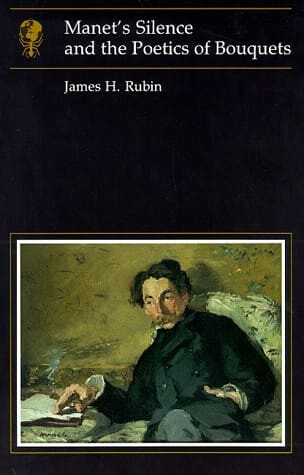
Manet’s Silence and the Poetics of Bouquets
James H. RubinFilled with revealing insights into Manet's achievement, this sensitive, informed and clearly written book goes a long way toward explaining why Manet's paintings continue to fascinate and elude us more than a century after the artist's death.
A sense of stillness and silence pervades Manet's works, whose flattened, sometimes fragmented figures appear to exist absent-mindedly in a world entirely lacking speech. It is this silence that James H. Rubin explores.
Manet's figural works, whether the early bohemian subjects or the elusive portraits and modern life themes of the later 1860s and 1870s, depend on visual exchanges and confrontations, or patterns of gazes, not on narrative. The 'aesthetic of silence' to be found in these works is poetically embodied in the displays of evocative flower studies and other still-lifes that Manet worked at throughout his career.
Filled with revealing insights into Manet's achievement, and into certain writings of three literary associates – Baudelaire, Zola and Mallarme – this sensitive, informed and clearly written book goes a long way toward explaining why Manet's paintings continue to fascinate and elude us more than a century after the artist's death.
Filled with revealing insights into Manet's achievement, this sensitive, informed and clearly written book goes a long way toward explaining why Manet's paintings continue to fascinate and elude us more than a century after the artist's death.
A sense of stillness and silence pervades Manet's works, whose flattened, sometimes fragmented figures appear to exist absent-mindedly in a world entirely lacking speech. It is this silence that James H. Rubin explores.
Manet's figural works, whether the early bohemian subjects or the elusive portraits and modern life themes of the later 1860s and 1870s, depend on visual exchanges and confrontations, or patterns of gazes, not on narrative. The 'aesthetic of silence' to be found in these works is poetically embodied in the displays of evocative flower studies and other still-lifes that Manet worked at throughout his career.
Filled with revealing insights into Manet's achievement, and into certain writings of three literary associates – Baudelaire, Zola and Mallarme – this sensitive, informed and clearly written book goes a long way toward explaining why Manet's paintings continue to fascinate and elude us more than a century after the artist's death.
James H. Rubin is Professor of Art History at the State University of New York, Stony Brook.