


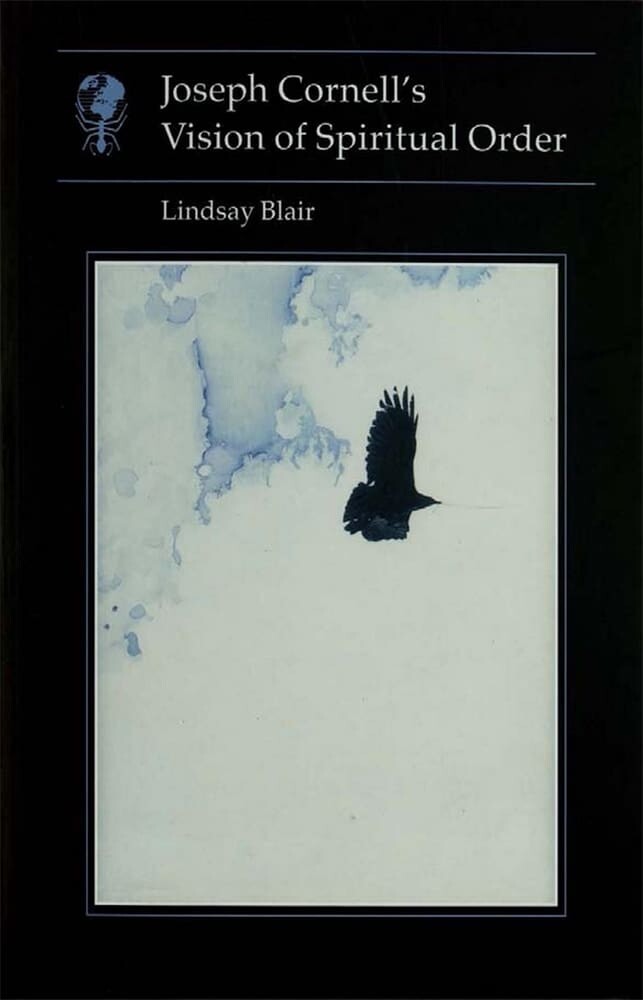
Joseph Cornell’s Vision of Spiritual Order
Lindsay BlairThe 'boxes' and collages constructed by Joseph Cornell (1903-72) are among the most intriguing and beguiling works of art made this century. This title presents us the picture of an artist who hid so much of his life from the world.
The ‘boxes’ and collages constructed by Joseph Cornell (1903-72) are among the most intriguing and beguiling works of art made this century. Old toys, photos, magazine illustrations, bits of electrical wiring - anything in fact more usually left to moulder in lumber rooms or junkshops - were hoarded by him as the elemental materials he needed for his constructions. The finished works are visually entrancing, but the intensely personal webs of reverie and association that determined their content make these boxes at once both oddly familiar yet ineluctably strange.
Drawing on the widest range possible of primary material - virtually all Cornell’s scrapbooks and source files, as well as correspondence and diaries - supplemented by further details gathered during more than fifty interviews undertaken with the artist's family and acquaintances, including Robert Motherwell and Susan Sontag, Lindsay Blair gives us the most detailed picture yet of an artist who hid so much of his life from the world. Her conclusion, wholly convincing in the light of the evidence she provides, is that Cornell’s ultimate subject was the mind itself.
The 'boxes' and collages constructed by Joseph Cornell (1903-72) are among the most intriguing and beguiling works of art made this century. This title presents us the picture of an artist who hid so much of his life from the world.
The ‘boxes’ and collages constructed by Joseph Cornell (1903-72) are among the most intriguing and beguiling works of art made this century. Old toys, photos, magazine illustrations, bits of electrical wiring - anything in fact more usually left to moulder in lumber rooms or junkshops - were hoarded by him as the elemental materials he needed for his constructions. The finished works are visually entrancing, but the intensely personal webs of reverie and association that determined their content make these boxes at once both oddly familiar yet ineluctably strange.
Drawing on the widest range possible of primary material - virtually all Cornell’s scrapbooks and source files, as well as correspondence and diaries - supplemented by further details gathered during more than fifty interviews undertaken with the artist's family and acquaintances, including Robert Motherwell and Susan Sontag, Lindsay Blair gives us the most detailed picture yet of an artist who hid so much of his life from the world. Her conclusion, wholly convincing in the light of the evidence she provides, is that Cornell’s ultimate subject was the mind itself.
-
'
. . . anyone with an interest in Cornell would appreciate and benefit from this publication
'The Art Book
-
'
a fascinating tour-de-force
'Midwest Book Review
-
'
Blair has led us one step closer to a fuller understanding of this famously enigmatic yet essential figure.
'Rain Taxi
Acknowledgements
Chronology
Introduction
1. The Self Observed
2. Origins of Selfhood
3. The Self in Others
4. The Cosmological Search
Conclusion
References
Select Bibliography
List of Illustrations
Lindsay Blair received her doctorate on Joseph Cornell from the University of Essex. She was Associate Producer of 'Joseph Cornell: Worlds in a Box', a BBC Omnibus programme first shown in 1991.