


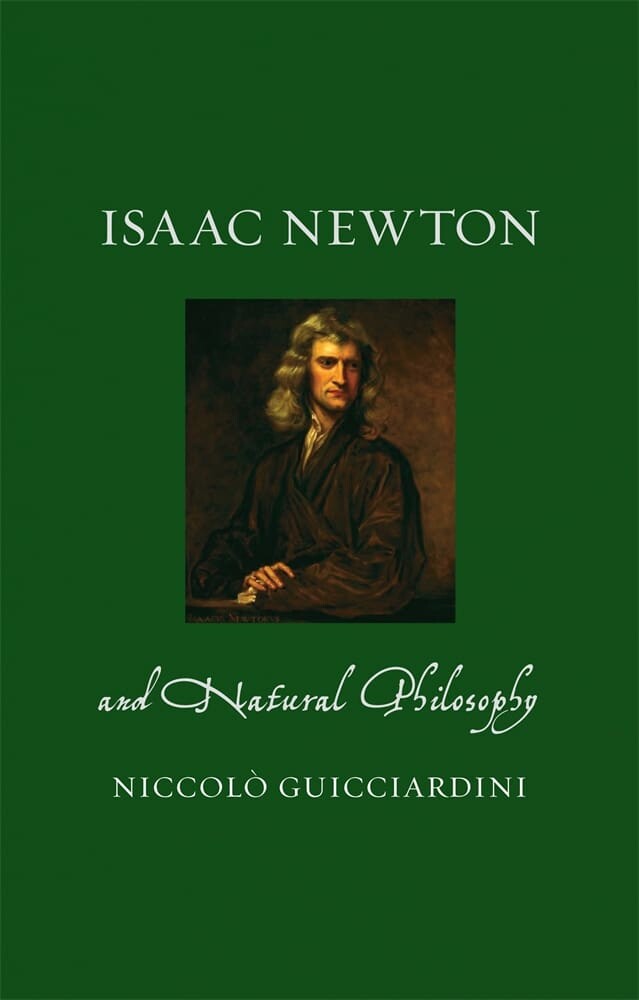
Isaac Newton and Natural Philosophy
Niccolò GuicciardiniIsaac Newton is regarded as one of the greatest scientists in history, yet the spectrum of his interests was much broader than that of a contemporary scientist. He was deeply involved in alchemical, religious and biblical studies, and in the later part of his life he played a prominent role in British politics, economics and the promotion of scientific research. His Philosophiæ naturalis principia mathematica, which sets out his laws of universal gravitation and motion, is regarded as one of the most important works in the history of science.
This enlightening biography offers an accessible introduction to Newton’s celebrated work in mathematics, optics, mechanics and astronomy and to how Newton viewed these scientific fields in relation to his quest for the deepest secrets of the universe, matter theory and religion. It sets Newton the natural philosopher in the troubled context of the religious and political debates that took place during his life, which spanned from the years of the Civil War to the Restoration, the Glorious Revolution and the Hanoverian succession. Taking into account the latest Newtonian scholarship, this fast-paced biography will appeal to all those with an interest in this iconic figure and the great scientific revolution of the early modern period.
Isaac Newton is regarded as one of the greatest scientists in history, yet the spectrum of his interests was much broader than that of a contemporary scientist. He was deeply involved in alchemical, religious and biblical studies, and in the later part of his life he played a prominent role in British politics, economics and the promotion of scientific research. His Philosophiæ naturalis principia mathematica, which sets out his laws of universal gravitation and motion, is regarded as one of the most important works in the history of science.
This enlightening biography offers an accessible introduction to Newton’s celebrated work in mathematics, optics, mechanics and astronomy and to how Newton viewed these scientific fields in relation to his quest for the deepest secrets of the universe, matter theory and religion. It sets Newton the natural philosopher in the troubled context of the religious and political debates that took place during his life, which spanned from the years of the Civil War to the Restoration, the Glorious Revolution and the Hanoverian succession. Taking into account the latest Newtonian scholarship, this fast-paced biography will appeal to all those with an interest in this iconic figure and the great scientific revolution of the early modern period.
-
'
A reader who . . . is daunted by the detail of Newman’s work would do well to begin with Niccolò Guicciardini’s Isaac Newton and Natural Philosophy which incorporates some of Newman’s previously published findings into a wonderfully clear account of Newton’s scientific thought as a whole.
'Dmitri Levitin, Literary Review
-
'
In this perceptive biography, Guicciardini provides a clear summary of Newton’s life of achievements and conflicts. The extensive index, detailed references, diagrams, photos, and bibliography aid researchers immensely. Highly recommended.
'Choice
-
'
While there are many excellent biographies of Newton, Guicciardini’s work is novel not only for its style of presentation but also for its form. The book is beautifully written, and the author uses a minimum of notes such that the reader is able to glide easily through the text without having to stop to verify and check sources and references. A scholarly work, the biography is also laden with over forty images that showcase Newton at the various stages of his life, his manuscripts, or relevant historical images. Many are in colour, and this adds to the beauty of the volume . . . Guicciardini’s solid biography of Newton succeeds in making Newton’s complex, sometimes contradictory life, accessible to the reader. The author shows not only the traditional philosopher and natural scientist but also the
'
metaphysician, theologian, public figure, alchemist, and historian.Renaissance and Reformation
-
'
This graceful biography is not intended to supersede such monumental works as Richard Westfall's Never at Rest . . . Instead, this beautifully designed book is meant to be an entry point for anyone interested in Newton. However, it surely is also a gem for professional historians of the early modern period, and even seasoned Newton scholars might find some refreshing insights in it. Guicciardini's profound knowledge of the subject shines through, especially on matters pertaining to Newton’s mathematical interests, on which the author is a leading scholar.
'Renaissance Quarterly
-
'
A very fine and very accessible account of one of science’s outstanding figures . . . Newton’s life is unfolded within a rich historical context, including much more than just the optical and gravitational science which immortalised his name . . . Professor Guicciardini is very well placed to deal with the technical aspects of Newton’s achievement, especially in optics, mechanics, and gravitation theory, all of which he treats in considerable detail, and with great lucidity
'The Observatory magazine
-
'
For readers seeking a well-crafted, beautifully illustrated, and impeccably researched, introduction to Newton’s mathematical accomplishments there is no need to look any further than this book.
'Journal of Modern History
-
'
Guicciardini’s narration does not downsize Newton’s originality; on the contrary, by leaving out the mythical elements it makes the reader still appreciate Newton’s exceptionality and the monumentality of his achievements. All this is attained in a pithy book accessible for its clarity to a broad audience: the amateur would be entertained; the scholar inspired.
'Nuncius
-
'
an excellent introduction to Newton’s life and work (including his theology, history, and alchemy, though with a greater emphasis on his mathematics and natural philosophy) . . . a highly engaging and historically astute survey of Newton’s life and work in context.
'Isis
-
'
Part of the Renaissance Lives series, this book is an elegant introduction to Isaac Newton, his works, and the wide field of Newtonian historiography . . . Guicciardini carefully reconstructs Newton’s religious beliefs against the background of seventeenth-century religious debates. Although he maintained heretical beliefs, Newton was able to exploit the religious and cultural climate of the Glorious Revolution to complete his social ascent through British society. By clearing the field of many old and new myths, this book provides a refreshing and readable account that will prove of great interest both to academic readers and the wider public.
'The Seventeenth Century
-
'
Guicciardini offers interested readers a particularly well-written and well-illustrated portrait of Newton the mathematician, Newton the alchemist, Newton the theologian, Newton the cosmologist, and perhaps most overlooked, Newton the survivor . . . Very enlightening.
'The Well-read Naturalist
-
'
What is there to be gained from another biographical treatment of Isaac Newton? This book is for those who are interested not so much in the biographical but the intellectual details. What specific puzzles did Newton face, how did he address them, and how did they shape his overall scientific oeuvre? Guicciardini presents in a short volume what until now had been treated mainly by specialists in the history of mathematics or physics . . . Guicciardini’s book is a model for how to approach the work of an innovator like Newton not only historically but also philosophically
'History of Physics Newsletter
-
'
In this elegant and perceptive biography, one of the leading scholars of Isaac Newton’s career provides a clear and often startling summary of the life of one of the greatest early modern scholars and philosophers of nature . . . The book offers a fascinating introduction to the aims and achievements of a towering figure of European intellectual culture.
'Simon Schaffer, Professor of History of Science, University of Cambridge
Niccolò Guicciardini teaches history of science at the University of Bergamo, Italy. He has devoted many years to studying Newton’s mathematical thought and its reception, and is the author of Reading the Principia: The Debate on Newton’s Mathematical Methods for Natural Philosophy from 1687 to 1736 (1999) and Isaac Newton on Mathematical Certainty and Method (2009).