


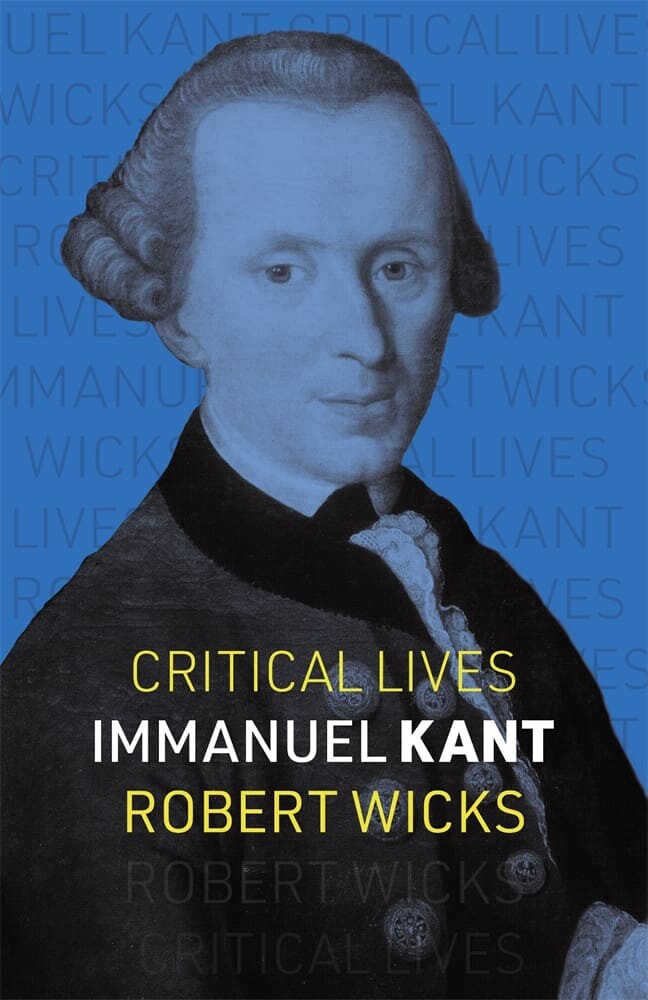
Immanuel Kant
Robert WicksIlluminating account of a key philosopher's life and ideas.
The great German philosopher Immanuel Kant (1724–1804) had astonishing conversational skills, was intelligently attentive to his frail physical constitution and lived with a single-minded dedication to the moral education of humanity. This concise biography highlights Kant as someone who embodied extreme intellectual ambition and unshakeable self-discipline. Robert Wicks explores the long-term influence of Kant’s Pietistic upbringing, the initial frustrations in his search for intellectual fame, his impressive friendships and his reactions to momentous historical events such as the French Revolution. He also considers critically the accusations that Kant was sexist, antisemitic and racist, and describes Kant's final years along with his philosophical legacy. This is an accessible, illuminating account of Kant’s complex philosophical ideas in the context of his life and times.
Illuminating account of a key philosopher's life and ideas.
The great German philosopher Immanuel Kant (1724–1804) had astonishing conversational skills, was intelligently attentive to his frail physical constitution and lived with a single-minded dedication to the moral education of humanity. This concise biography highlights Kant as someone who embodied extreme intellectual ambition and unshakeable self-discipline. Robert Wicks explores the long-term influence of Kant’s Pietistic upbringing, the initial frustrations in his search for intellectual fame, his impressive friendships and his reactions to momentous historical events such as the French Revolution. He also considers critically the accusations that Kant was sexist, antisemitic and racist, and describes Kant's final years along with his philosophical legacy. This is an accessible, illuminating account of Kant’s complex philosophical ideas in the context of his life and times.
-
'
The Kant that emerges from these pages is less dull and more recognisably human than his metronomic image . . . This book is a pleasant enough stroll through Kant's life, his key ideas and his legacy.
'The Spectator
-
'
Written for the general reader, Wick’s brisk biography of Kant gives us three valuable things: a sense of the man, a generous set of discussions of his writings, and the needed context – historical, philosophical, and scientific – to better appreciate why Kant’s ideas were so important in his day and are still “a big deal” in our own.
'Steve Naragon, Professor Emeritus of Philosophy, Manchester University, Indiana, and editor of Portraits of Kant
-
'
Robert Wicks’s splendid book reintegrates Kant’s epochal philosophy into his remarkable life, illuminating both. Lucid, informative, imaginative and accurate, it is engaging for general readers and for students of Kant at any level.
'Kenneth R. Westphal, Member of Academia Europaea and author of Kant's Critical Epistemology
Introduction
1 Königsberg and the World Scene in the 1700s
2 Pietism, Kant, Königsberg and Casanova
3 Kant at the University: The Living Body in a Mechanistic World
4 The Theist, Astronomer and Socialite
5 The Best Friend, the Spirit-Seer and the Dogmatic Slumbers
6 The ‘Silent Decade’: Space and Time as ‘Imaginary’
7 Kant’s ‘Table Society’ and his Battles against a New Era
8 The Writings of the 1780s: Kant’s Three Critiques
9 The Final Years
Epilogue: Kant’s Legacy
References
Select Bibliography
Acknowledgements
Photo Acknowledgements
Robert Wicks is Professor of Philosophy at the University of Auckland. Among other books on nineteenth-century philosophy, he is the author of Kant on Judgment (2007) and Introduction to Existentialism: From Kierkegaard to ‘The Seventh Seal’ (2020).