


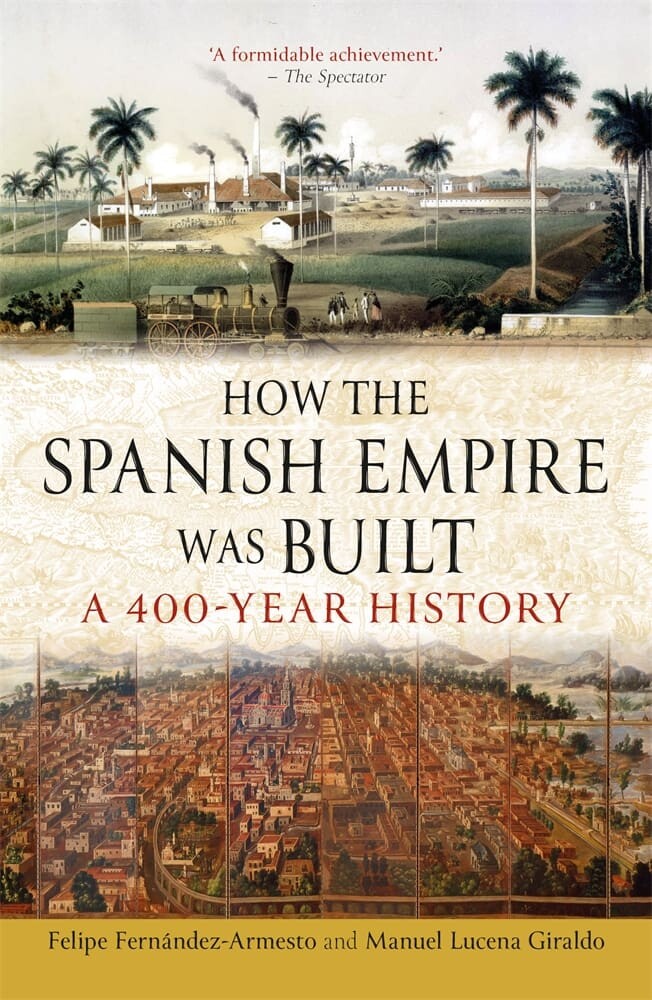
How the Spanish Empire Was Built
A 400-Year History
Felipe Fernández-Armesto, Manuel Lucena GiraldoA fast-paced and entertaining journey through four hundred years of Latin American and Spanish history
In the sixteenth century, Spain was small and divided, yet it built the largest empire in history. How? Felipe Fernández-Armesto and Manuel Lucena Giraldo reveal the crucial role of engineers in this achievement. By investing in infrastructure that benefited local elites, Spain expanded its influence and enriched trade networks. Through vivid stories of engineers, prospectors, soldiers and priests, the authors bring Spanish America’s age of conquest to life. Now in paperback, this dazzling history redefines empire as a venture shaped by collaboration as well as oppression, offering fresh insights into the rise of the Spanish Empire and the complexities of its legacy.
A fast-paced and entertaining journey through four hundred years of Latin American and Spanish history
In the sixteenth century, Spain was small and divided, yet it built the largest empire in history. How? Felipe Fernández-Armesto and Manuel Lucena Giraldo reveal the crucial role of engineers in this achievement. By investing in infrastructure that benefited local elites, Spain expanded its influence and enriched trade networks. Through vivid stories of engineers, prospectors, soldiers and priests, the authors bring Spanish America’s age of conquest to life. Now in paperback, this dazzling history redefines empire as a venture shaped by collaboration as well as oppression, offering fresh insights into the rise of the Spanish Empire and the complexities of its legacy.
A fast-paced and entertaining journey through four hundred years of Latin American and Spanish history
In the sixteenth century, Spain was small and divided, yet it built the largest empire in history. How? Felipe Fernández-Armesto and Manuel Lucena Giraldo reveal the crucial role of engineers in this achievement. By investing in infrastructure that benefited local elites, Spain expanded its influence and enriched trade networks. Through vivid stories of engineers, prospectors, soldiers and priests, the authors bring Spanish America’s age of conquest to life. Now in paperback, this dazzling history redefines empire as a venture shaped by collaboration as well as oppression, offering fresh insights into the rise of the Spanish Empire and the complexities of its legacy.
-
'
'The world’s most successful empires have been engineers’ creations.’ This assertion, made by Fernández-Armesto and Lucena Giraldo in How the Spanish Empire Was Built: A 400-Year History, seems bold at first, almost audacious. Yet within the span of the book’s first two chapters, the authors’ contention seems not only logical and wise but almost irrefutable. . . . A richly researched account of the clever, industrious and deeply practical men who followed in the footsteps, often literally, of Columbus, Cortés, Pizarro, Núñez de Balboa and others. The mission of these takers of territory was completed, the authors argue, by the engineers—makers of ‘the scaffolding . . . on which empire was erected.’
'Wall Street Journal
-
'
How the Spanish Empire was Built is extraordinarily learned, and gilded with linguistic flourishes.
'Literary Review
-
'
A formidable achievement
'David Crane, The Spectator
-
'
"What have the Spaniards ever done for us?" imperial subjects may have asked, plotting rebellion. "Aqueducts?" One may have ventured. "Okay, aqueducts. What else?" "Appeals courts?" "Right! Appeals courts. And?" "Well, the mails?" "Okay. So there are the aqueducts, the appeals courts, the royal mail. But really, what have the Spaniards ever done for us?" "Hospitals?" "The transoceanic fleet system?" "Defensive fortifications?" "Arched bridges?" "A standardized writing system?" One gets the idea. Certain to spark heated discussions like this one, How the Spanish Empire was Built offers a comprehensive defense of Spanish logistical ingenuity, a neo-Roman project of truly global dimensions. Known mostly to Spanish historians of science and engineering until now, the logistical stuff of empire, what made it function day-by-day for so long despite the tyranny of distance, the temptations of corruption, and the relentless downward tug of entropy, has remained obscure to most Anglophone readers. In an age obsessed with global supply chains, instant communications, and global epidemics, there is much to be learned from predecessors who first encircled the world, for better or worse. The authors say this is simply a book about the "scaffolding of empire," but it is about much more. It is a provocation.
'Kris Lane, Tulane University
-
'
Be prepared: Fernández-Armesto and Lucena Giraldo will sweep you off the solid ground of what you thought you knew about empire, as they dive beneath the scholarly wave of structuralism to find an infrastructural undertow. But fear not. In the hands of these historical engineers, as witty as they are erudite, this manual for how to make an empire offers an answer to an old question: how on earth did imperialists do it? And their answer is as well designed, built, and fortified as Spain’s colonial enterprise mostly seems to have been.
'Matthew Restall, author of Seven Myths of the Spanish Conquest and When Montezuma Met Cortés
-
'
An essential book, magisterially written . . . in a limpid, clear style, without sacrificing academic rigour.
'Fernando R. Lafuente, ABC, Spain
-
'
[The authors] explore an under-appreciated yet essential dimension of the Spanish Empire: the public works which allowed . . . a small European minority to control, develop and defend a vast territory.
'Alfonso López, National Geographic España
-
'
The authors demonstrate a rare capacity to make accessible a voluminous knowledge of the reality of the overseas territories of the Spanish Monarchy . . . [this book] should be in the library of every lover of American history.
'Maria Saavedra, El Debate
Preface
Introduction: Making Empire Work
1 Enter the Engineers: Amateurs and Professionals in the Making of Infrastructure
2 The Oceanic Scaffolding: Maritime Communications
3 Making Ways: Landward Communications
4 Troubled Waters: Along and Across Internal Waterways
5 The Rings of Stone: Fortifying the Frontiers
6 On the Waterfront: Ports and Shipyards
7 The Public Sphere: Social and Economic Infrastructure
8 Health Infrastructure: Hospitals and Sanitation
9 The Missionary Frontier: Missions as Infrastructure
10 The Last Century: Engineers in the Aftermath of Empire
References
Acknowledgements
Index
Felipe Fernández-Armesto (Author)
Felipe Fernández-Armesto is William P. Reynolds Professor of History at the University of Notre Dame. His work has appeared in 29 languages and has won, among other awards, the World History Association Book Prize, the John Carter Brown Medal, and Spain’s national prizes for geographical research and food writing. His books include Straits (2022) and Out of Our Minds (2019).
Manuel Lucena Giraldo (Author)
Manuel Lucena Giraldo is a Research Scientist at the Spanish National Research Council and Adjunct Professor at IE University and ESCP Business School Europe. His most recent book is Firsting in the Early-Modern Atlantic World (2020, ed. Lauren Beck).