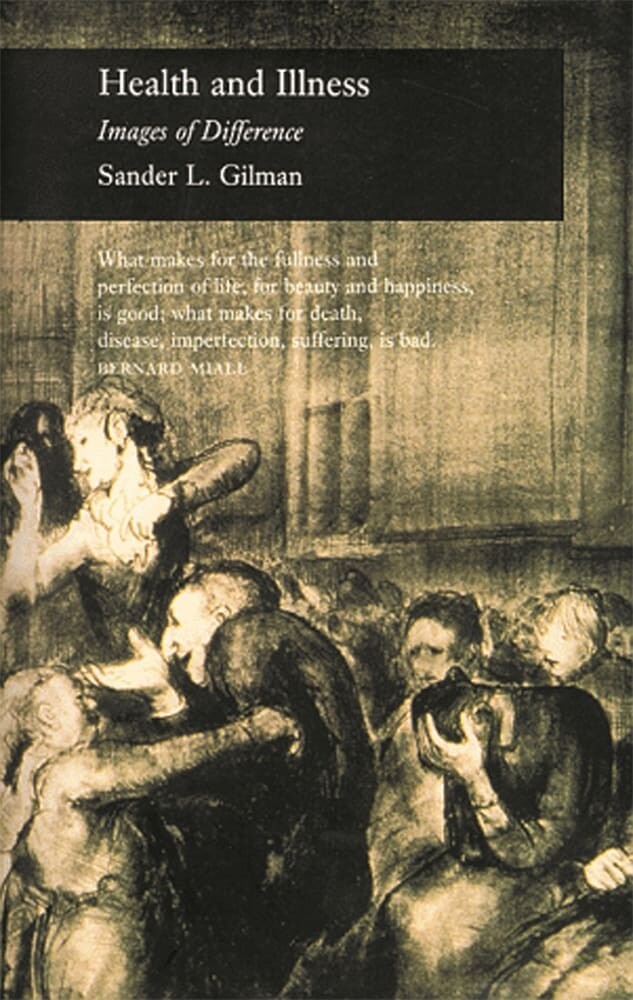
Health and Illness
Images of Difference
Sander L. GilmanOurs is a culture riddled with preoccupations about health and disease. In this timely study Sander L. Gilman demonstrates how images of beauty and ugliness have constructed a visual history which records the artificial boundaries that continue to divide ‘healthy’ bodies from ones that are ill. He shows how cultural fantasies of health and illness have come to be identified and defined by means of visual, aesthetic criteria – for the healthy is now seen as beautiful and the ill as ugly.
How did these categories acquire medical associations? The history of our perception of the ‘beautiful body’ is charged with anxieties about contagion and ugliness and, furthermore, entangled with political implications brought about by our all-too-frequent interpretation of ‘race’ as a medical category. Sander Gilman looks at how nineteenth-century theorists collected medical and racial data from the shapes of noses, and at contemporary fears concerning syphilis, vividly personified in the diseased hero of Leroux’s The Phantom of the Opéra. He also scrutinizes Mark Twain’s frank account of a visit to the Holy Land for signs of implicit prejudice about the health or illness of the resident Arabs and Jews. These concerns are brought up-to-date when the author turns to pathological case histories and recent AIDS posters issued by governments worldwide.
This is more than simply a history of medicine augmented by visual evidence; its true originality lies in reading from the same visual sources an otherwise unnoticed aestheticization of the body. In so doing, Sander Gilman has discovered a new, exciting, alternative reading of the history of health and illness.
Ours is a culture riddled with preoccupations about health and disease. In this timely study Sander L. Gilman demonstrates how images of beauty and ugliness have constructed a visual history which records the artificial boundaries that continue to divide ‘healthy’ bodies from ones that are ill. He shows how cultural fantasies of health and illness have come to be identified and defined by means of visual, aesthetic criteria – for the healthy is now seen as beautiful and the ill as ugly.
How did these categories acquire medical associations? The history of our perception of the ‘beautiful body’ is charged with anxieties about contagion and ugliness and, furthermore, entangled with political implications brought about by our all-too-frequent interpretation of ‘race’ as a medical category. Sander Gilman looks at how nineteenth-century theorists collected medical and racial data from the shapes of noses, and at contemporary fears concerning syphilis, vividly personified in the diseased hero of Leroux’s The Phantom of the Opéra. He also scrutinizes Mark Twain’s frank account of a visit to the Holy Land for signs of implicit prejudice about the health or illness of the resident Arabs and Jews. These concerns are brought up-to-date when the author turns to pathological case histories and recent AIDS posters issued by governments worldwide.
This is more than simply a history of medicine augmented by visual evidence; its true originality lies in reading from the same visual sources an otherwise unnoticed aestheticization of the body. In so doing, Sander Gilman has discovered a new, exciting, alternative reading of the history of health and illness.
-
'
Gilman tells an excellent tale.
'Jewish Chronicle
-
'
Gilman offers up the ambiguity of fantasies about health and illness for discursive redemption by his readers, providing insights without judgements . . . a stimulating synthetic work which reaches a new level of originality, provokes new questions and points toward further directions.
'Oxford Art Journal
Acknowledgements
1. How and Why do Historians of Medicine Use or Ignore Images in Writing their Histories?
2. Again Madness as a Test Case
3. The Ugly and the Beautiful
4. The Phantom of the Opéra's Nose
5. Mark Twain and Hysteria in the Holy Land
6. The Beautiful Body and AIDS
Towards a Conclusion
References
Photographic Acknowledgements
Index
Sander L. Gilman is Distinguished Professor of the Liberal Arts and Sciences as well as Professor of Psychiatry at Emory University. A cultural and literary historian, he is the author or editor of more than ninety books.