


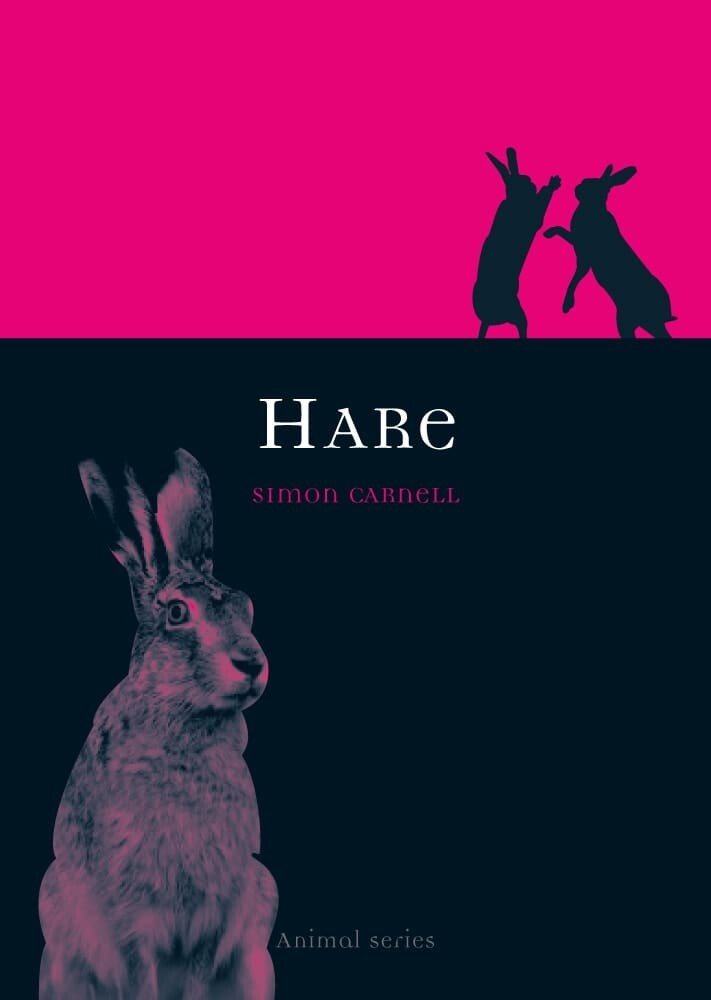
Hare
Simon CarnellTracking the hare from ancient Egypt, where a hieroglyph of the animal signified existence itself, to the serial hare works of artist Joseph Beuys, this book finds its subject in many surprising places and forms: from Crucifixion scenes, Buddhist lore and Algonquin creation myths, to witch trials, treatises on logic, and contemporary poetry.
Colourfully described by early natural historians as the ‘fastest, hairiest, most lascivious, and most melancholy’ of mammals, the hare is no less remarkable for its actual behaviour and capacities than for the intriguing ways in which it has been imagined and exploited throughout history. Hare examines how this animal has been described, symbolized and visually depicted, as well as utilized for its fur, flesh and exceptional speed.
Tracking the hare from ancient Egypt, where a hieroglyph of the animal signified existence itself, to the serial hare works of artist Joseph Beuys, who once notoriously declared that ‘I am not a human being, I am a hare’, Hare finds its subject in many surprising places and forms: from Crucifixion scenes, Buddhist lore and Algonquin creation myths, to witch trials, treatises on logic, contemporary poetry and an art installation in a Dutch brothel. It is the principal subject of the first ever hunting treatise, ‘king of all venery’, for Renaissance theorists of the hunt; and it appears in the first known description of a still-life painting, in the first signed and dated picture of a single animal, and in early medicine, where it was credited with having the most curative properties of any ‘beaste’.
The first monograph on the subject for 35 years, and richly illustrated, Hare combines the most recent natural history with an eclectic account of the animal’s symbolic values. Hare will be of interest to art historians and literary critics; to those for and opposed to hunting; and to both the general and the lagophile reader alike.
Tracking the hare from ancient Egypt, where a hieroglyph of the animal signified existence itself, to the serial hare works of artist Joseph Beuys, this book finds its subject in many surprising places and forms: from Crucifixion scenes, Buddhist lore and Algonquin creation myths, to witch trials, treatises on logic, and contemporary poetry.
Colourfully described by early natural historians as the ‘fastest, hairiest, most lascivious, and most melancholy’ of mammals, the hare is no less remarkable for its actual behaviour and capacities than for the intriguing ways in which it has been imagined and exploited throughout history. Hare examines how this animal has been described, symbolized and visually depicted, as well as utilized for its fur, flesh and exceptional speed.
Tracking the hare from ancient Egypt, where a hieroglyph of the animal signified existence itself, to the serial hare works of artist Joseph Beuys, who once notoriously declared that ‘I am not a human being, I am a hare’, Hare finds its subject in many surprising places and forms: from Crucifixion scenes, Buddhist lore and Algonquin creation myths, to witch trials, treatises on logic, contemporary poetry and an art installation in a Dutch brothel. It is the principal subject of the first ever hunting treatise, ‘king of all venery’, for Renaissance theorists of the hunt; and it appears in the first known description of a still-life painting, in the first signed and dated picture of a single animal, and in early medicine, where it was credited with having the most curative properties of any ‘beaste’.
The first monograph on the subject for 35 years, and richly illustrated, Hare combines the most recent natural history with an eclectic account of the animal’s symbolic values. Hare will be of interest to art historians and literary critics; to those for and opposed to hunting; and to both the general and the lagophile reader alike.
-
'
I love the hare book
'Paul Muldoon
-
'
The hunted, the subversive, the lascivious and the victim: the hare has been many things during its lengthy history and Simon Carnells delightful pocket-sized book presents the story in an ingenious fashion. Natural history is blended with beautiful illustrations as the hares place in myth, art, religion and the sporting sphere is delicately interwoven . . .
'The Field
-
'
The newest in Reaktions wonderful series of richly illustrated books dedicated to individual animals, this is the first monograph in 35 years on one of the most fascinating of British animals. It considers the hare in history and art through the ages, explores its symbolic values, and provides the latest thinking on its behaviour, capabilities and physical nature.
'Country Life
-
'
In Hare, Simon Carnell trawls through the art, legend, law and literature of this elusive quadruped that has had a more-than-fleeting presence in our culture . . . an intriguing survey
'New Statesman
-
'
Hare is impressively executed . . . Carnell is an excellent guide through centuries of hare representations. He has an objectivity that serves his purpose well, in that he can offer excellent insights into human thinking. Rarely did I find Carnell's own attitudes intrusive.
'House Rabbit Journal
-
'
A quite fascinating book that seemed to be the epitome of this fabulous animal. A must read and at what a bargain price.
'Highland News
1 Lagographia Curiosa: The Natural and Unnatural History of the Hare
2 Mythic Hare
3 Hunted Hare
4 Painted and Plastic Hare
5 Hare Poetry, Hare Thought
Epilogue: Hare Writing
Timeline
References
Select Bibliography
Associations and Websites
Acknowledgements
Photo Acknowledgements
Index
Simon Carnell is a freelance writer, reviewer, translator and poet. He has reviewed for and published poems in many publications including the TLS, Sunday Times, Spectator, New Statesman, Guardian, London Review of Books, Poetry Review, Harvard Review and Modern Painters, and he is the author of Notes of Several Experiments (2003).