Goya
The Last Carnival
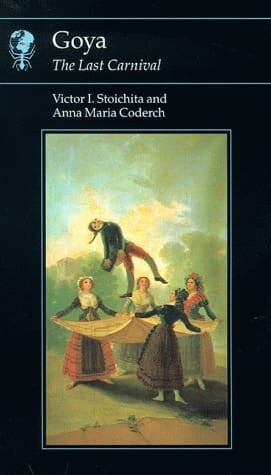
Victor I. StoichitaThis text provides a new reading of Goya, concentrating on the closing years of the 18th century as a neglected milestone in his life. Goya waited until 1799 to publish his celebrated series of drawings, the "Caprichos", which offered a personal vision of the "world turned upside down".
This intriguing book on Goya concentrates on the closing years of the eighteenth century as a neglected milestone in his life. Goya waited until 1799 to publish his celebrated series of drawings, the Caprichos, which offered a personal vision of the ‘world turned upside down’. Victor I. Stoichita and Anna Maria Coderch consider how themes of Revolution and Carnival (both seen as inversions of the established order) were obsessions in Spanish culture in this period, and make provocative connections between the close of the 1700s and the approaching end of the Millennium. Particular emphasis is placed on the artist's links to the underground tradition of the grotesque, the ugly and the violent. Goya's drawings, considered as a personal and secret laboratory, are foregrounded in a study that also reinterprets his paintings and engravings in the cultural context of his time.
This text provides a new reading of Goya, concentrating on the closing years of the 18th century as a neglected milestone in his life. Goya waited until 1799 to publish his celebrated series of drawings, the "Caprichos", which offered a personal vision of the "world turned upside down".
This intriguing book on Goya concentrates on the closing years of the eighteenth century as a neglected milestone in his life. Goya waited until 1799 to publish his celebrated series of drawings, the Caprichos, which offered a personal vision of the ‘world turned upside down’. Victor I. Stoichita and Anna Maria Coderch consider how themes of Revolution and Carnival (both seen as inversions of the established order) were obsessions in Spanish culture in this period, and make provocative connections between the close of the 1700s and the approaching end of the Millennium. Particular emphasis is placed on the artist's links to the underground tradition of the grotesque, the ugly and the violent. Goya's drawings, considered as a personal and secret laboratory, are foregrounded in a study that also reinterprets his paintings and engravings in the cultural context of his time.
Preface and Acknowledgements
1. The Turn of the Century as a Symbolic Form
2. The Carnival Is Dead, Long Live the Carnival!
3. Vertigo
4. Clinic of Pure Reason
5. Goya's Pharmacy
6. The Carnival of Language
7. Royal Games
8. Ha-ha, Ho-ho, Hu-hu, He-he!
Appendix: Publicity Notice from the Diario de Madrid, 6 February 1799
References
List of Illustrations
Victor I. Stoichita is Professor of Modern Art History at the University of Fribourg, Switzerland. He is the author of Visionary Experience in the Golden Age of Spanish Art (1997) and A Short History of the Shadow (1997, 2019), and co-author with Anna-Maria Coderch of Goya: The Last Carnival (1999), all published by Reaktion Books.