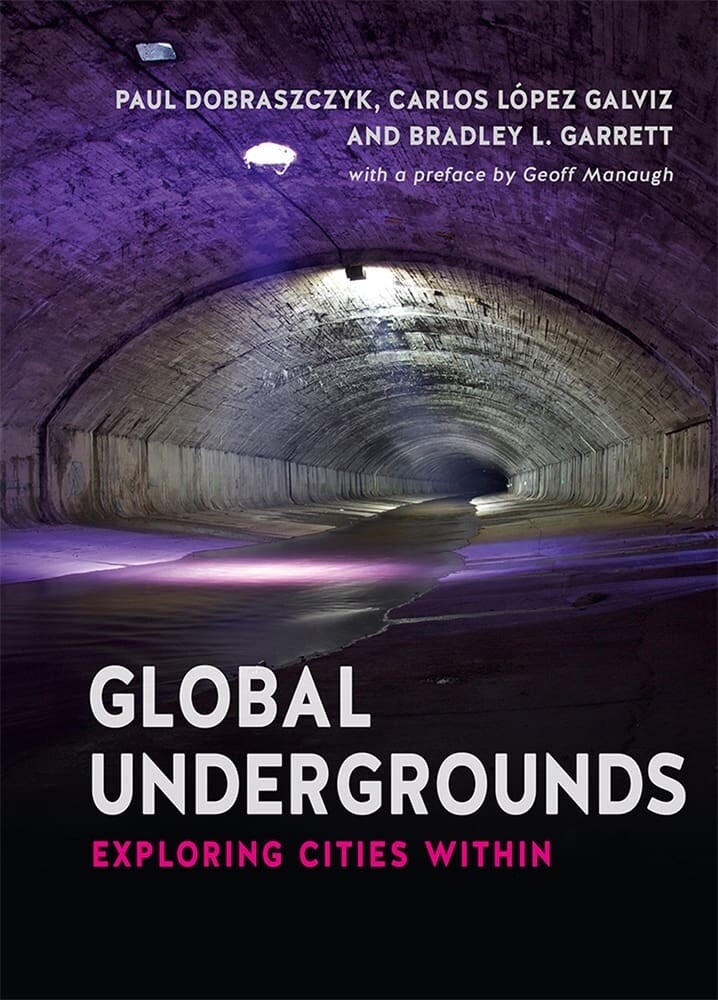
Global Undergrounds
Exploring Cities Within
Paul Dobraszczyk, Carlos López GalvisA stunning, beautifully illustrated exploration of urban underground spaces, bringing together a collection of 80 subterranean sites from around the world.
Over the last two centuries, the world’s cities have undergone dramatic vertical, above-ground transformations. But at the same time, they have sunk themselves into the ground, in the form of sprawling tendons of tunnels, caverns and bunkers – conduits for transport, utilities and communication or spaces of shelter and storage. Global Undergrounds charts the global reach of urban underground spaces, collecting 80 stories of subterranean sites around the world to reveal the profound – but often unseen – ways they have changed our lives.
Illustrated with breath-taking photographs, this book exposes the remarkable diversity of manmade underground environments, from their astonishing range of architectural approaches to the many cultural meanings they carry, whether as places of hope, fear, memory, labour or political resistance. Undergrounds are places that can tell a city’s oldest stories or foresee its most distant futures; they are places ultimately of both incredible depth and breadth, serving city dwellers not just with the logistics of day-to-day life but as crucial parts of a city’s mythology.
A stunning, beautifully illustrated exploration of urban underground spaces, bringing together a collection of 80 subterranean sites from around the world.
Over the last two centuries, the world’s cities have undergone dramatic vertical, above-ground transformations. But at the same time, they have sunk themselves into the ground, in the form of sprawling tendons of tunnels, caverns and bunkers – conduits for transport, utilities and communication or spaces of shelter and storage. Global Undergrounds charts the global reach of urban underground spaces, collecting 80 stories of subterranean sites around the world to reveal the profound – but often unseen – ways they have changed our lives.
Illustrated with breath-taking photographs, this book exposes the remarkable diversity of manmade underground environments, from their astonishing range of architectural approaches to the many cultural meanings they carry, whether as places of hope, fear, memory, labour or political resistance. Undergrounds are places that can tell a city’s oldest stories or foresee its most distant futures; they are places ultimately of both incredible depth and breadth, serving city dwellers not just with the logistics of day-to-day life but as crucial parts of a city’s mythology.
-
'
well worth dipping into for its worldwide take on the sheer variety of ways we humans have spun our subterranean webs . . . These underground stories remind us that buried spaces are places of protection as well as of the fearfully unknown, of hope and of political resistance, of science as well as persistent chthonic mythology. Theres always a quirky and sometimes a grisly journey to be had beneath our streets.
'London Evening Standard
-
'
Global Undergrounds serves as a catalog that positions 80 underground sites of urban, suburban, and rural development, and most segments offer a connection to the culture of the present and the past . . . Diverse authors offer approaches as academics, official visitors, tourists, or adventurers, engaging with spaces and places that usually remain hidden from both sight and mind.
'Popmatters
-
'
treats the subject properly and carefully the editors acknowledge that this is a world not often seen, one hidden to nearly all, yet one which holds a fascination for anyone who wonders what lies beneath their feet. It is done extremely well, specially as the layout is appealing, being enriched with colour photographs of sometimes obscure underground places it is a book to dip into that becomes difficult not to dip into the next section of engaging text . . . Cavers, mine historians and urban explorers will all enjoy this read . . . a substantial and attractive book book with diversity as its major strength.
'Descent Magazine
-
'
Global Undergrounds takes us fascinatingly deep into the unknown worlds of the urban subterrane: the hidden zones where we store, hide, secure, repress, bury and extract. For a book so concerned with darkness, it dazzles in its curiosity, wit and knowledge. This bunker-Baedeker opens a new vision of the city to us the vertical city, extending far above our heads and far below our feet.
'Robert Macfarlane, author of Landmarks and The Old Ways: A Journey on Foot
-
'
The volume takes a unique shape, composed of eighty brief essays, each around two pages, from twenty-six contributors. Their geographic reach is truly global, touching every continent. Each contribution analyzes an underground site, memorably and often personally, in a style that varies from autobiographical to journalistic or ethnographic, which strongly suggests travel narrative. The book is richly illustrated with color images, mostly photographs by the contributors. Though not as systematic as an encyclopedia, the collection was similarly assembled from voluntary contributions. More scholarly than an atlas or travel guide but equally attuned to particular spaces, places, and their various social uses and meanings, the book could well inspire travel or urban exploration.
'H-Urban
Preface
Global Undergrounds
Geoff Manaugh
Introduction
Exploring Cities Within
Paul Dobraszcyk, Carlos Lopez Galviz and Bradley L. Garrett
Origins
Taming the Quagmire: Cloaca Maxima, Rome
Journey of an Underground Army: Xi’an
Protective Labyrinths: Sint Petersburg Tunnels, Maastricht
A Skiff, Fish and Wells: Basilica Cistern, Istanbul
Old, Deep, and Discreet: Cappadocia’s Underground Cities
Under Kingdom: the Layers of Mexico City
Labour
Absurd Space: Williamson Tunnels, Liverpool
Hidden Labour: Broad Street Subway, Philadelphia
Salt of a Mining Cathedral: Zipaquirá, Colombia
Human Life Underground: Vale un Potosí, Bolivia
Infrastructural Fetishism: York Metro Extension, Toronto
Wares, Rights and Stars: Delhi’s Metro and Bazar
Dwelling
Underground Outback: Coober Pedy, Australia
Beneath the Neon: Flood Channels, Las Vegas
Death Squads and Firebombs: Sewers of Bogotá
Mateship Below: Melbourne Drains
Class Dividers: Lower Wacker Drive, Chicago
Diggers and Deserters: Odessa Catacombs
Refuse
Into the Vortex: Brighton Sewers
Waste and Work: New York City Sewers
Lost Undergrounds: Atlantic Avenue Tunnel, New York
Repressed Wastes: London’s Sewers
Burying Incomprehensible Horror: Yucca Mountain Nuclear Storage
Memory
Sinking Histories: Berlin’s S- and U-Bahn tunnels
Bunker Art: Christian and Karen Boros Collection, Berlin
Bedrock Memories: Nottingham’s Caves
Remembering the Map: Prestwich Memorial, Cape Town
Underground Clouds: Hong Kong Data Centres
Mirror of History: Berlin’s Water Tower
Ghosts
Haunted Spaces: Edinburgh’s Medieval Vaults
Visiting the Dead: London’s Victorian Catacombs
Temporal Disjunctions: Abandoned London Underground
Adopting the Dead: Fontanelle Cementery, Naples
Communist Ghosts: Plovdiv Seismological Lab
Orpheus in the Air-raid Shelter: Underground Theatre, Prague
Fear
Striving Underground: Stockholm’s Atomic Bomb Defences
Sheltered Lives: Shanghai Civil Defence Shelters
Remote Shelter: Andersgrotta, Norway
Defence of the Nation: National Redoubt, Switzerland
Undergrounds at War: London’s Second World War Bunkers
Tortoises, Oranges and Giant Tunnels: Bunkers, Albania
Surface Terror: Tokyo Chikatetsu
Security
Dark Tourism and Data Dumps: Reusing Missile Silos in the American West
Subterranean Insurgency: Joint Tunnel Test Range, Arizona
Sent Down: Oxford’s Prison Tunnels
Under Control: Metro, Santiago de Chile
Crossing Borders: Tijuana and San Diego
Vertical War Zones: Gaza Tunnels
Resistance
Insurgent Strongholds: The ‘Hidden City’ of Viengxay
Defensible Spaces: The Underground Cities of Kinmen and Matsu
Ideology and Fear: Prague Metro
Intractable Histories: Moscow’s Secret River
Reverse Modernization: Saw Mill River, New York City
Remaindered Flows: The Irk Culvert, Manchester
Renderings
Subterranean Sublimes: Roden Crater, Arizona
Remaindered Spaces: Manchester’s Air-raid Shelters
Under Construction: Buenos Aires Subte
Cinematic Space: Vienna’s Sewers and The Third Man
Remaking the Map: Golden Acre, Cape Town
Encountering Undergrounds: Levitated Mass, Los Angeles
Cameras and Cleaning Balls: Paris Sewers
Exposure:
As Above, So Below: Paris Catacombs
Cracks in the System: Antwerp Pre-metro
Urban Layers: Athens
Secret City: Burlington, Wiltshire
Under the Ice: Polar Undergrounds
The City and the City: Underground Seattle
Edges
Urban Rhythms: St Petersburg Metro
Unruly Spaces: Cairo Metro
Edge of Existence: Abandoned Bratislava Metro
Mystic Caverns: Grand Central Terminal, New York
Buried Waterways: Brescia Underground
Off the Map: Cape Town Tunnels
Futures
Futures Past: Pyongyang Metro
Sleeping Dragons: Future Ruins of CERN
Segregating Symbols: Dubai’s Metro
The Great Society: Washington’s Metro
Slow Modernity: Sofia Metro
Time Underground: The Clock of the Long Now
After the End: Svalbard Global Seed Vault
References
Notes on Contributors
Photo Acknowledgements
Paul Dobraszczyk (Anthology Editor)
Paul Dobraszczyk is a writer and a teaching fellow at the Bartlett School of Architecture, London. He is the author of Future Cities (Reaktion, 2019) and co-editor of Global Undergrounds: Exploring Cities Within (Reaktion, 2016).
Carlos López Galvis (Anthology Editor)
Carlos López Galviz is a lecturer and research fellow at the Institute for Social Futures at Lancaster University. He is the co-editor of Going Underground: New Perspectives (2013).
Bradley L. Garrett (Anthology Editor)
Bradley L. Garrett is research fellow in the School of Geosciences at the University of Sydney. His books include Explore Everything: Place-hacking the City (2013) and Subterranean London: Cracking the Capital (2014).