


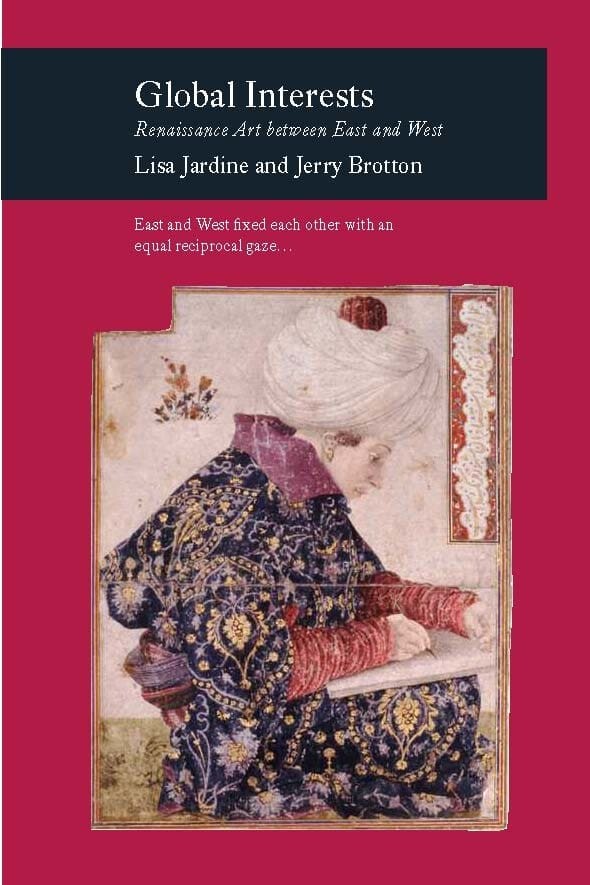
Global Interests
Renaissance Art between East and West
Lisa Jardine, Jerry BrottonA wide-ranging reassessment of Renaissance art that examines the ways in which European culture came to define itself culturally and aesthetically in the years 1450 to 1550.
In this radical and wide-ranging reassessment of Renaissance art, Jerry Brotton and Lisa Jardine examine the ways in which European culture came to define itself culturally and aesthetically in the years 1450 to 1550. Looking outwards for confirmation of who they were and of what defined them as ‘civilized’, Europeans encountered the returning gaze of what we now call the East, in particular the powerful Ottoman Empire of Mehmed the Conqueror and Süleyman the Magnificent. Global Interests explores these historical interactions by offering new and exciting accounts of three often neglected art objects: portrait medals, tapestries and equestrian art. The portability of medals and tapestries, and the transportability of, and esteem accorded to, pure-bred Eastern horses made them frequently exchanged objects, and, as such, highly revealing of the cultural currents flowing between Occident and Orient. The authors provide fascinating new responses to some of the most iconic paintings of the period, including the work of Pisanello, Leonardo, Dürer, Holbein and Titian.
Global Interests also offers a timely reassessment of the development of European imperialism, focusing on the Habsburg Empire of Charles V, and concludes with a consideration of the impact this history continues to have upon contemporary perceptions of European culture and ethnic identity.
A wide-ranging reassessment of Renaissance art that examines the ways in which European culture came to define itself culturally and aesthetically in the years 1450 to 1550.
In this radical and wide-ranging reassessment of Renaissance art, Jerry Brotton and Lisa Jardine examine the ways in which European culture came to define itself culturally and aesthetically in the years 1450 to 1550. Looking outwards for confirmation of who they were and of what defined them as ‘civilized’, Europeans encountered the returning gaze of what we now call the East, in particular the powerful Ottoman Empire of Mehmed the Conqueror and Süleyman the Magnificent. Global Interests explores these historical interactions by offering new and exciting accounts of three often neglected art objects: portrait medals, tapestries and equestrian art. The portability of medals and tapestries, and the transportability of, and esteem accorded to, pure-bred Eastern horses made them frequently exchanged objects, and, as such, highly revealing of the cultural currents flowing between Occident and Orient. The authors provide fascinating new responses to some of the most iconic paintings of the period, including the work of Pisanello, Leonardo, Dürer, Holbein and Titian.
Global Interests also offers a timely reassessment of the development of European imperialism, focusing on the Habsburg Empire of Charles V, and concludes with a consideration of the impact this history continues to have upon contemporary perceptions of European culture and ethnic identity.
A wide-ranging reassessment of Renaissance art that examines the ways in which European culture came to define itself culturally and aesthetically in the years 1450 to 1550.
In this radical and wide-ranging reassessment of Renaissance art, Jerry Brotton and Lisa Jardine examine the ways in which European culture came to define itself culturally and aesthetically in the years 1450 to 1550. Looking outwards for confirmation of who they were and of what defined them as ‘civilized’, Europeans encountered the returning gaze of what we now call the East, in particular the powerful Ottoman Empire of Mehmed the Conqueror and Süleyman the Magnificent. Global Interests explores these historical interactions by offering new and exciting accounts of three often neglected art objects: portrait medals, tapestries and equestrian art. The portability of medals and tapestries, and the transportability of, and esteem accorded to, pure-bred Eastern horses made them frequently exchanged objects, and, as such, highly revealing of the cultural currents flowing between Occident and Orient. The authors provide fascinating new responses to some of the most iconic paintings of the period, including the work of Pisanello, Leonardo, Dürer, Holbein and Titian.
Global Interests also offers a timely reassessment of the development of European imperialism, focusing on the Habsburg Empire of Charles V, and concludes with a consideration of the impact this history continues to have upon contemporary perceptions of European culture and ethnic identity.
Lisa Jardine (Author)
Lisa Jardine is Director of the AHRB Research Centre for Editing Lives and Letters, Professor of Renaissance Studies at University College London, and author of many books.
Jerry Brotton (Author)
Jerry Brotton is Professor of Renaissance Studies at Queen Mary, University of London and a leading expert in the history of cartography. He presented the BBC4 series Maps: Power, Plunder and Possession in 2010, and is the author of numerous critically acclaimed books, including Global Interests: Renaissance Art between East and West (Reaktion, 2000), co-written with Lisa Jardine, and the bestselling and prize-winning A History of the World in Twelve Maps (2012).