


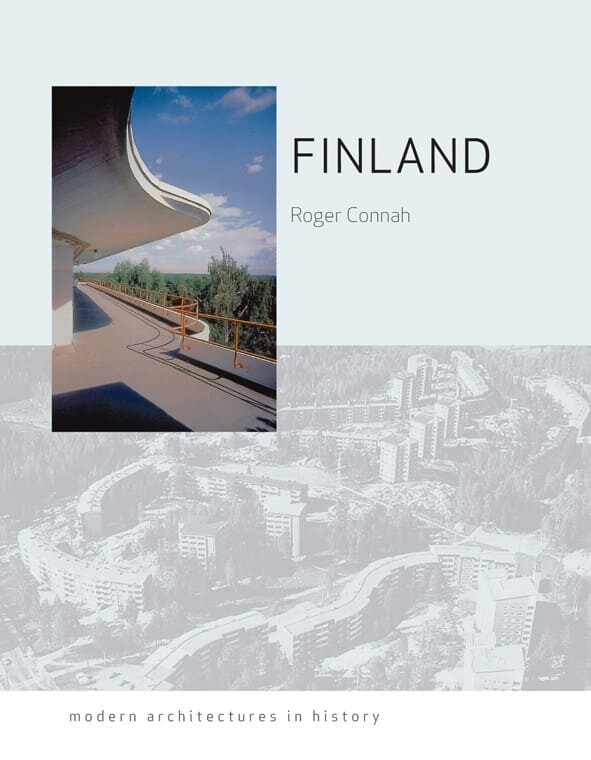
Finland
Modern Architectures in History
Roger ConnahExplores the shape of architecture from Finland's independence in 1917. This book assesses the work of well-known heroes of Finnish architecture and others, whose contributions are little known outside Finland. It also discusses the developments in architecture, in relation to the culture and politics of the independent Finland.
From as early as 1900 Finland, at that time ruled by Russia, was to see in architecture a political and social vehicle. Modern architecture, with the promises it held for social change and hopes for technological progress, was to become a cultural phenomenon over the course of the twentieth century. This book explores the shape of architecture from Finland’s independence in 1917 until the present day, and how the ‘modern agenda’ became a blueprint to advance the nation’s society and define its identity.
Roger Connah assesses the work of well-known heroes of Finnish architecture such as Reima Pietila, Juha Leiviskä and ‘modern master’ Alvar Aalto, as well as many other less familiar figures whose contribution is little known outside Finland. He discusses developments in architecture in relation to the culture and politics of the new independent Finland, as well as parallel movements in the arts, and also surveys the early part of the century, as Finland came into its own as a new nation state. He examines the rationalised developments of the 1930s, the ‘organic’ and vernacular tendencies of modern architecture, and how some of modernism’s devices were combined with a particular Nordic sensibility. He also looks at the reconstruction and urbanisation of the post-war years, the use of industrial building methods and prefabricated materials, the ‘golden age’ of Finnish modernism in the 1950s, and the developments thereafter. Connah also considers how architecture has been publicised in magazines, galleries and through exhibitions.
By the end of the twentieth century Finland had transformed itself into a modern industrial economy at the cutting edge of the world, and its buildings continue to be regarded as exemplary modern works. Roger Connah assesses Finnish modern architecture’s relation to the broader cultural and political conditions of Finland and modernity at large, making this study crucial to our understanding of Finland’s place in architecture and in culture today.
Explores the shape of architecture from Finland's independence in 1917. This book assesses the work of well-known heroes of Finnish architecture and others, whose contributions are little known outside Finland. It also discusses the developments in architecture, in relation to the culture and politics of the independent Finland.
From as early as 1900 Finland, at that time ruled by Russia, was to see in architecture a political and social vehicle. Modern architecture, with the promises it held for social change and hopes for technological progress, was to become a cultural phenomenon over the course of the twentieth century. This book explores the shape of architecture from Finland’s independence in 1917 until the present day, and how the ‘modern agenda’ became a blueprint to advance the nation’s society and define its identity.
Roger Connah assesses the work of well-known heroes of Finnish architecture such as Reima Pietila, Juha Leiviskä and ‘modern master’ Alvar Aalto, as well as many other less familiar figures whose contribution is little known outside Finland. He discusses developments in architecture in relation to the culture and politics of the new independent Finland, as well as parallel movements in the arts, and also surveys the early part of the century, as Finland came into its own as a new nation state. He examines the rationalised developments of the 1930s, the ‘organic’ and vernacular tendencies of modern architecture, and how some of modernism’s devices were combined with a particular Nordic sensibility. He also looks at the reconstruction and urbanisation of the post-war years, the use of industrial building methods and prefabricated materials, the ‘golden age’ of Finnish modernism in the 1950s, and the developments thereafter. Connah also considers how architecture has been publicised in magazines, galleries and through exhibitions.
By the end of the twentieth century Finland had transformed itself into a modern industrial economy at the cutting edge of the world, and its buildings continue to be regarded as exemplary modern works. Roger Connah assesses Finnish modern architecture’s relation to the broader cultural and political conditions of Finland and modernity at large, making this study crucial to our understanding of Finland’s place in architecture and in culture today.
-
'
. . . in Finland, Roger Connah assumes the architectural historians most arduous challenge: He examines a sweeping panorama of a nation's cultural and political currents and shows how these helped shape architectural creativity. The broadly erudite Connah details the complex and often-paradoxical struggles faced by generations of architects whose designs mirrored a shifting sense of Finnish identity . . . Nearly 200 small but sharply focused halftones invite further investigation of modern Finnish architecture, an invitation amplified by the authors lyrical prose.
'Architectural Record
-
'
Finland is the necessary critical examination of the evolution of modernism in Finnish architecture with its essential role in shaping national identity. Connahs systematic interweaving of the political, social, cultural, and artistic milieux transforms the narrative into an engaging journey over Finlands twentieth-century architectural landscape and its emergence as a modern nation.
'Journal of Scandinavian Studies
Introduction: Modern Architecture and the Shape of History
1. Pioneering Finnish Modernism
2. Independence: Rehearsals for Modernism
3. White Functionalism: The Modern Agenda
4. War: Standardization and Solidarity
5. Expressive Modernism: The Banquet Years
6. Fellow Travelling: Militancy, Mies, and Constructivism
7. Deconstruction and Reconstruction
8. Late Modernism, Critical Humanism
Epilogue: History and the Shape of Modernism
References
Select Bibliography
Acknowledgements
Photo Acknowledgements
Index
Roger Connah is a writer and educator. He has taught in Helsinki and Stockholm and has recently been Visiting Professor at the University of Texas, Arlington. His previous publications include Writing Architecture (1989), k/k: A Couple of Finns and Some Donald Ducks (1991), Aaltomania (2001), and 40/40: Young Architects from Finland (2002).