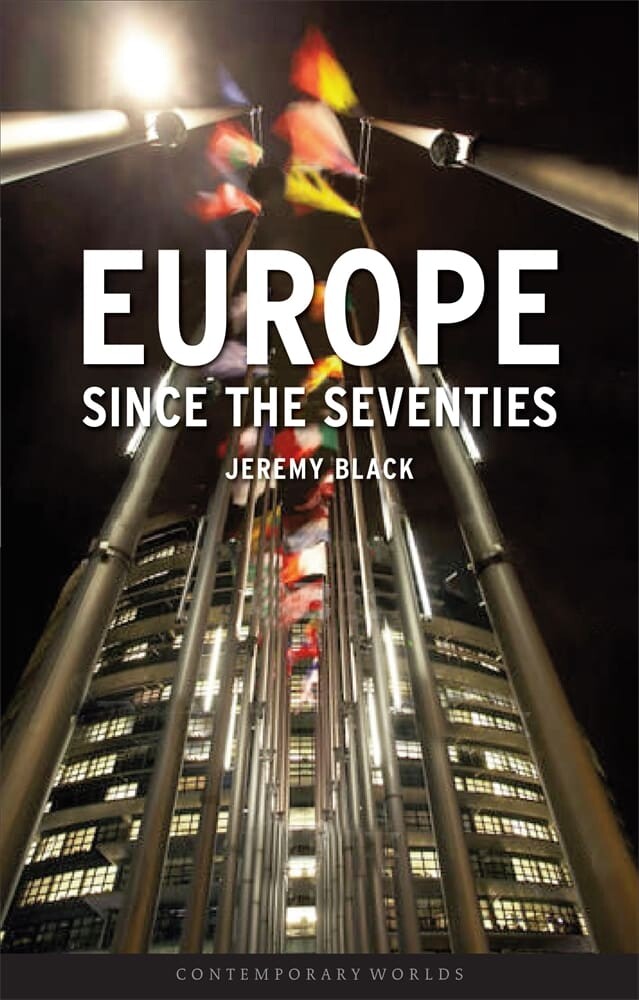
Europe since the Seventies
Jeremy BlackProvides an analysis of the ways in which history and culture, economics and society have remade Europe in recent times. This book gives full treatment to environmental, demographic and cultural issues, alongside political, societal and economic matters, as well as taking in subjects such as crime, migration and transport.
Jeremy Black provides a succinct and authoritative analysis of the ways in which history and culture, economics and society have remade Europe in recent times. While his account reaches back to 1945, the main focus is on the last four decades. What emerges are the seeds for present issues that were sown in the past.
Europe since the Seventies gives full treatment to environmental, demographic and cultural issues, alongside political, societal and economic matters, as well as taking in subjects such as crime, migration and transport. Jeremy Black reveals how European society has changed markedly since 1970: former mappings of the elements of society, based on economic activity and opportunity and understood in terms of class, have given way to issues of identity – notably questions of gender, but also sexual orientation, race and consumerism. Europe has expanded its frontiers and the European Union has become a testing ground for all manner of aspirations.
A timely, readable and cogent account, this latest volume from eminent historian Jeremy Black illuminates today’s Europe through the lens of recent history.
Provides an analysis of the ways in which history and culture, economics and society have remade Europe in recent times. This book gives full treatment to environmental, demographic and cultural issues, alongside political, societal and economic matters, as well as taking in subjects such as crime, migration and transport.
Jeremy Black provides a succinct and authoritative analysis of the ways in which history and culture, economics and society have remade Europe in recent times. While his account reaches back to 1945, the main focus is on the last four decades. What emerges are the seeds for present issues that were sown in the past.
Europe since the Seventies gives full treatment to environmental, demographic and cultural issues, alongside political, societal and economic matters, as well as taking in subjects such as crime, migration and transport. Jeremy Black reveals how European society has changed markedly since 1970: former mappings of the elements of society, based on economic activity and opportunity and understood in terms of class, have given way to issues of identity – notably questions of gender, but also sexual orientation, race and consumerism. Europe has expanded its frontiers and the European Union has become a testing ground for all manner of aspirations.
A timely, readable and cogent account, this latest volume from eminent historian Jeremy Black illuminates today’s Europe through the lens of recent history.
-
'
Contending that the year 1945 as the by-now-traditional caesura is too remote for 21st-century students of contemporary history, Black reviews European environmental, social, economic, and political trends since the 1970s in chapters by turns insightful but sometimes cursory. A liberal critic of the European Union, he convincingly reveals its democratic deficits, especially its top-heavy bureaucracy, which very often sets a corporatist agenda against constituents wishes . . . Recommended.
'Choice
-
'
Black presents a well-structured, well-balanced and well-informed overview of the major developments in Europe since the 1970s. He does not hide his personal views, for instance, about the EUs Common Agricultural Policy, the European Social Model, or President Mitterrand . . . Nevertheless, Black is reflexive about his own preconceptions. As evidence of the resilience of different national perspectives, he notes, his book provides a liberal, anti-dirigiste British view.
'Journal of Contemporary European Studies
-
'
The greatest strength of Europe since the Seventies is Blacks ability to weave a historical narrative that continually speaks to present-day concerns, including economic recession, environmental change, European integration, and challenges to national identity posed by immigration.
'H-net reviews
Preface
1. Introduction: Europe 1945-70
2. Environment Transformed?
3. Changing Peoples
4. Social Developments
5. Ideology and Culture
6. Economic Worlds
7. Politics to 1991
8. Politics, 1992 to the Present
9. Current Issues
Selected Further Reading
Index
Jeremy Black is Professor of History at the University of Exeter. One of Britain’s leading military historians, he has written over eighty books, including: Maps and Politics (Reaktion, 1996), Why Wars Happen (Reaktion, 1998), Britain since the Seventies (Reaktion, 2004), War since 1945 (Reaktion, 2004), Altered States: America since the Sixties (2004), all published by Reaktion.