


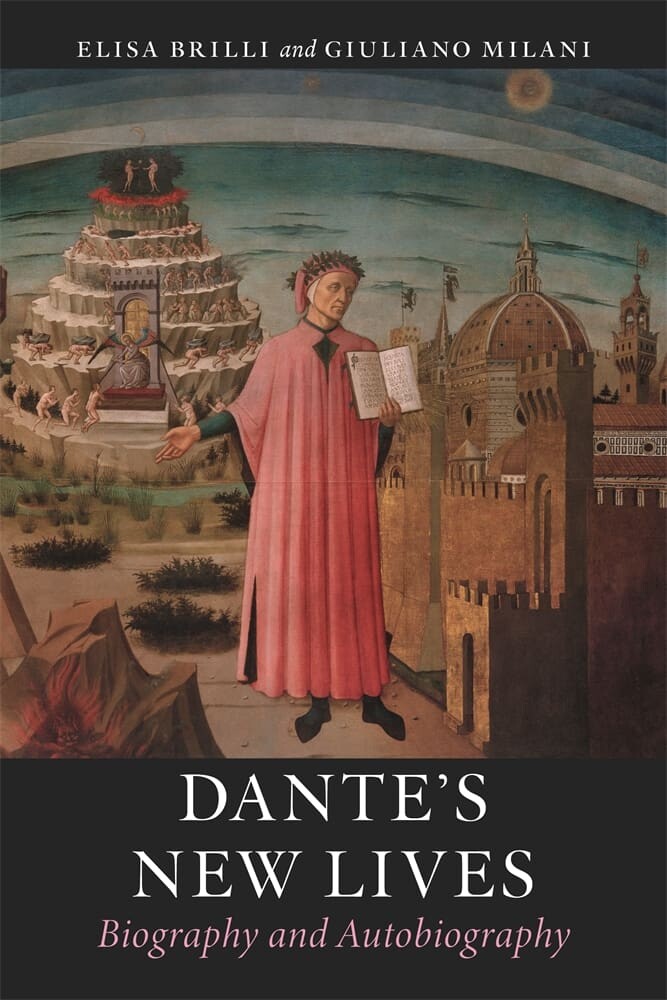
Dante’s New Lives
Biography and Autobiography
Elisa Brilli, Giuliano MilaniA fascinating, rigorous, wide-ranging reappraisal of Dante Alighieri’s life and work.
Numerous books have attempted to chronicle the life of Dante Alighieri, yet essential questions remain unanswered. What path did this self-taught Florentine follow to become the celebrated author of the Divine Comedy? Was Dante’s exile from Florence so extraordinary? How did Dante make himself the main protagonist in his works, in a literary context that discouraged such a practice? And why has his life captivated the interest of so many readers? In Dante’s New Lives, eminent scholars Elisa Brilli and Giuliano Milani provide comprehensive answers to these questions and many more. Their account reappraises Dante’s life and work by meticulously assessing archival and literary evidence and examining the most recent scholarship. It is a model of interdisciplinary biography, a compelling blend of fascination and rigour.
A fascinating, rigorous, wide-ranging reappraisal of Dante Alighieri’s life and work.
Numerous books have attempted to chronicle the life of Dante Alighieri, yet essential questions remain unanswered. What path did this self-taught Florentine follow to become the celebrated author of the Divine Comedy? Was Dante’s exile from Florence so extraordinary? How did Dante make himself the main protagonist in his works, in a literary context that discouraged such a practice? And why has his life captivated the interest of so many readers? In Dante’s New Lives, eminent scholars Elisa Brilli and Giuliano Milani provide comprehensive answers to these questions and many more. Their account reappraises Dante’s life and work by meticulously assessing archival and literary evidence and examining the most recent scholarship. It is a model of interdisciplinary biography, a compelling blend of fascination and rigour.
-
'
The title of Elisa Brilli and Giuliano Milani’s new biography of Dante points back to the Vita nova, but also suggests that their book brings something new . . . In practice this means much political, social and cultural history, juxtaposed with discussions of the roles Dante envisaged for his work and for himself . . . Dante’s New Lives makes it plain that it wants the reader to take an active part in the process of reconstruction, and offers impressive examples of what can be done in this respect. It also tries to reach out to a broad readership by quoting Italian and Latin texts solely in English, while affirming its scholarly credentials with 100 pages of notes and an up-to-date bibliography.
'Times Literary Supplement
-
'
A scholarly introduction to Dante's life and times that illuminates the poet’s achievement as a pioneer of the common tongue . . . Dante himself claimed that life progresses through distinct stages: adolescence, youth, old age and finally senility . . . The book progresses through these stages with meticulous and erudite detail . . . [it] provides a rich tapestry . . . Reading Dante’s New Lives could well provide an encouraging context for many, who have hitherto taken too literally the poet’s own well-known quotation: ‘abandon hope all ye who enter here’ and instead to venture forth.
'Morning Star
-
'
Across the historical and critical record, many different – and often contradictory – accounts of Dante’s life have been assembled from a rather vague biographical profile. Brilli and Milani offer a unique and thoughtful reappraisal of the life of Dante, a composite portrait that relies heavily on a thorough account of the archival, critical, and literary evidence. The starting point is not the birth and family lineage of the poet, but instead a consideration of Florence in thirteenth-century Italy, a city with "a rich and complex" history integral to the person Dante was to become. The authors deftly combine the personal, social, political, and artistic threads of his Dante's life, offering an understanding that is deeper and more realistic than most. Recommended.
'Choice
-
'
Elisa Brilli and Giuliano Milani’s stimulating book, published in Italian and French prior to this accomplished English translation by Mary Maschio and Eva Plesnik, offers an account of Dante’s life that pointedly separates the documented Dante from the poet’s ‘lifelong elaboration of many different narratives about himself’ . . . This is a distinctive, authoritative, and meticulously researched contribution to the study of Dante’s biography and his enduring interest in ‘life writing’ and self-representation . . . In separating the historical evidence from Dante’s textual self-fashioning, while bringing the two into cautious but stimulating forms of dialogue, Brilli and Milani’s ‘problematic restoration’ at once destabilizes and enriches our understanding of a medieval poet’s life.
'The Medieval Review
-
'
The book is very much worth the time and attention of both Dante fans and enthusiastic readers of biography. It’s a very pleasingly dense examination of everything we know or can know about the life of the Commedia’s great poet . . . In these pages our authors have constructed a magnificently detailed "life and times" of their subject. They delve into his genealogy; they recreate his childhood, his relatives, his playgrounds, his schooling, the twists and turns of his adulthood, in a mass of detail that manages to be incredibly formidable but also invitingly readable throughout. Their respect for all those different shards and avenues of evidence guarantees that no scrap of Dante lore is overlooked or plowed into bland generalizations . . . Aficionados of the poet and his story – people, for instance, who devoured John Took’s fiercely brilliant Dante back in 2020 – will feel happily surrounded.
'Open Letters Review
-
'
Dante’s New Lives stands out among recent Dante biographies for its interdisciplinary approach and innovative methodology. By clearly separating historical documents from autobiographical writing and analysing both within their specific contexts, Brilli and Milani present a critical rethinking of how Dante’s life can be approached, interpreted, and narrated. Their approach also enables readers to distinguish clearly between Dante as a historical figure, about whom we have limited information, and the way he constructed and reshaped his identity through his works. The book is already a milestone in Dante Studies, and this clear and accurate translation makes it accessible to a wider audience than specialists. Its emphasis on reconstructing the historical and social contexts of Dante’s life, along with its effort to provide a thorough intellectual profile of the author, makes it particularly suitable for university students in the English-speaking world who are approaching the study of Dante’s life and works for the first time.
'Modern Language Review
-
'
An immense gift to Dante scholars and to non-specialists alike, this is a wonderfully readable account of Dante’s life, work and times. Brilli and Milani’s biography offers an ideal model of the powers of interdisciplinary collaboration, putting historical documents into dialogue with Dante’s own stories of his life. Here, as never before, we see Dante’s life illuminated by the expertise that a literary scholar and a medieval historian can, together, offer.
'Heather Webb, Professor of Medieval Italian Literature and Culture, University of Cambridge, and Fellow of Selwyn College
-
'
Sophisticated, thoroughly researched and ecumenical in approach – this is the biography of Dante for the next generation. Instead of chasing illusory scoops, Brilli and Milani probe the elusive relationship between an artist’s life and their works. Highly recommended.
'Justin Steinberg, Professor of Italian Literature, University of Chicago, and Editor-in-Chief of Dante Studies
-
'
A splendidly calibrated restoration of the many “lives” of Dante, this book brings to the English-speaking audience a highly original and very accessible take on the fascinating story of Dante’s life and times. Establishing both dialogue and contrast between documents, history, reported narratives and Dante’s own autobiography, Brilli and Milani show the elusive intrigue of the “truth” of a medieval life.
'Elena Lombardi, Professor of Italian Literature, University of Oxford, Fellow of Balliol College
Abbreviations and Works Cited
Preface
Prologue: Lineages
1 Adolescence
2 Youth in Florence
3 Youth in Exile
4 Old Age
Epilogue: Legacies
References
Bibliography
Index
Elisa Brilli (Author)
Elisa Brilli is Professor in Italian Studies and Medieval Studies at the University of Toronto. Her many books include Firenze e il profeta: Dante fra teologia e politica (2012).
Giuliano Milani (Author)
Giuliano Milani is Professor in Medieval History at the Université Gustave Eiffel in Paris, France. His books include L’homme à la bourse au cou: Généalogies et usage d’une image médiévale (2019).