


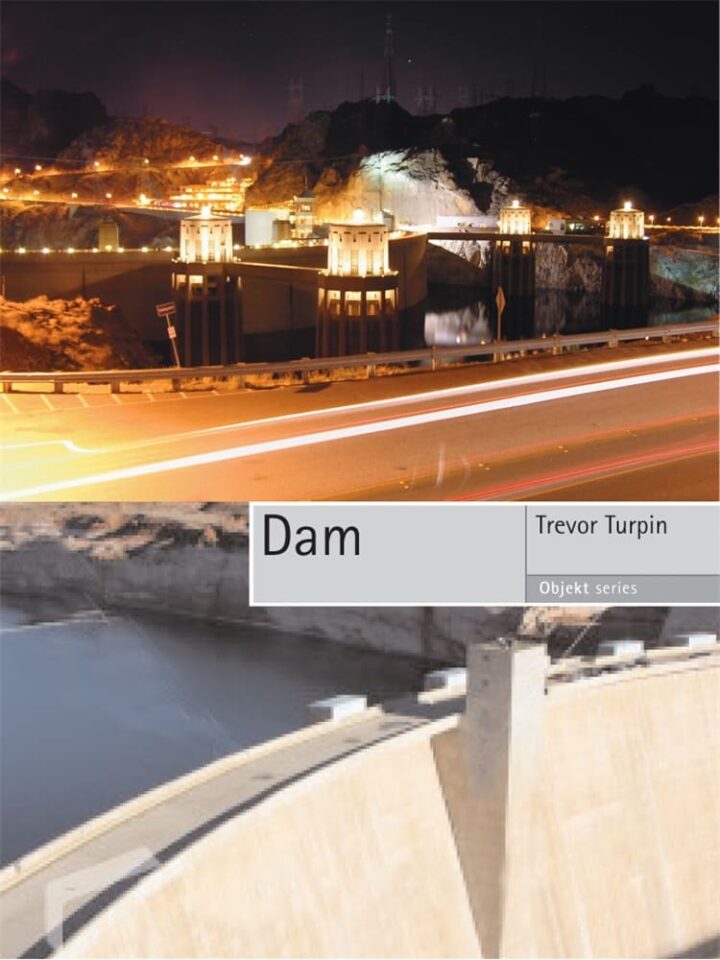
Dam
Trevor TurpinAs well as much-needed electricity, dams generate extremes of emotion. This book traces the development of dams from the Industrial Revolution onwards. It offers an account of their design, construction and function, which may appeal to general readers and those interested in environmental policy, history and civil engineering.
As well as much-needed electricity, dams generate extremes of emotion. Traditionally, dams have facilitated hydraulic civilizations such as those in the Nile Valley, China and Mesopotamia, and, in the twentieth century, Las Vegas and Los Angeles. Yet with the proliferation of dams – there are now more than 40,000 large dams worldwide – opposition and support can be measured in equal proportion. Their outstanding design and construction, often in inhospitable conditions, is representative of the skills of their engineers, yet others do not see such beauty in the ‘taming’ of rivers. In 1998 the continuing controversy led to the forming of the World Commission on Dams to seek a meeting of minds.
Dam, a new addition to Reaktion’s Objekt series, traces the development of dams from the Industrial Revolution to the present day through a number of themes – both successes and failures – including the extension of the design teams forming an alliance between engineering, architecture, landscape architecture and ecology.
A profusely illustrated exploration of a previously neglected subject, this book is neither a polemic against dams nor a defence of their proliferation. It offers a fresh and much-needed account of their design, construction and function, which will appeal to general readers and those interested in environmental policy, history and civil engineering.
As well as much-needed electricity, dams generate extremes of emotion. This book traces the development of dams from the Industrial Revolution onwards. It offers an account of their design, construction and function, which may appeal to general readers and those interested in environmental policy, history and civil engineering.
As well as much-needed electricity, dams generate extremes of emotion. Traditionally, dams have facilitated hydraulic civilizations such as those in the Nile Valley, China and Mesopotamia, and, in the twentieth century, Las Vegas and Los Angeles. Yet with the proliferation of dams – there are now more than 40,000 large dams worldwide – opposition and support can be measured in equal proportion. Their outstanding design and construction, often in inhospitable conditions, is representative of the skills of their engineers, yet others do not see such beauty in the ‘taming’ of rivers. In 1998 the continuing controversy led to the forming of the World Commission on Dams to seek a meeting of minds.
Dam, a new addition to Reaktion’s Objekt series, traces the development of dams from the Industrial Revolution to the present day through a number of themes – both successes and failures – including the extension of the design teams forming an alliance between engineering, architecture, landscape architecture and ecology.
A profusely illustrated exploration of a previously neglected subject, this book is neither a polemic against dams nor a defence of their proliferation. It offers a fresh and much-needed account of their design, construction and function, which will appeal to general readers and those interested in environmental policy, history and civil engineering.
-
'
Here, dams take centre stage as their design, construction, beauty, failures and environmental consequences are analysed. Building Design
'Building Design
-
'
Turpins book is very readable and in only 256 pages encompasses a remarkable depth and breadth of the history and context of dams in their multiple guises. The book is richly illustrated with photographs of the dams and images of posters and other historical materials. The book will be of interest to engineers, academics, and environmentalists, as well as the general reader.
'Water Alternatives
-
'
Dam investigates some of the worlds most famous and awe-inspiring dams and will be of interest to engineers, historians and environmentalists at all levels . . . beautifully illustrated.
'The Environmentalist
-
'
Turpins book will be of particular interest to engineers, environmentalists and historians and, because it is well written and well illustrated, also to the broader reading public. I thoroughly recommend it.
'Dams and Reservoirs
-
'
With the current movement toward dam removals in the Western world, it is interesting to see a book that treats dams as buildings of particular significance. This books approach is not technical, but historical. It presents dams under different perspectives: as symbols of dominance, works of designers, and objects of beauty. It also covers dam failures and the recent backlash against dams . . . Recommended.
'Choice
Introduction
1 Dam as Symbol and Function
2 Dam Designers and Builders
3 Dam Beauty and Dam Proud
4 Dam Failure
5 Dam Angry
6 What Environment?
Postscript
Glossary
References
Select Bibliography
Acknowledgements
Photographic Acknowledgements
Index
Trevor Turpin is a Visiting Lecturer at the University of Bath, and has worked in water and environmental management since the early 1970s. He is the co-author of Environmental Impact Assessment Handbook (2002).