


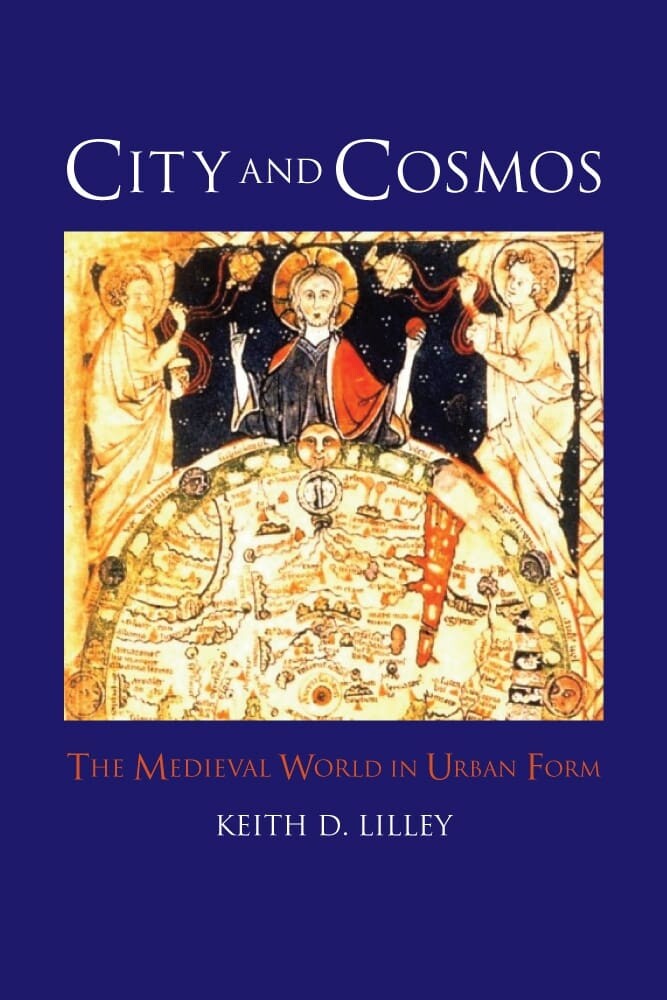
City and Cosmos
The Medieval World in Urban Form
Keith D. LilleyAn exploration of the city represented in the medieval imagination. Drawing upon original accounts, illustrations and maps from across medieval Europe, and on science, religion, art, literature, drama and architecture of the Latin West, it offers an interpretation of how medieval Christians saw their urban worlds.
City and Cosmos is an exploration of ‘the city’ represented in the medieval imagination. Keith D. Lilley shows that, to the medieval mind, the city was not merely a ‘collection of houses’, it was an idea rich in Christian symbolism and cosmological meaning.
Drawing upon original accounts, illustrations and maps from across medieval Europe, and on science, religion, art, literature, drama and architecture of the Latin West, City and Cosmos offers an innovative interpretation of how medieval Christians saw their urban worlds. Linking together textual and visual evidence, it examines how the city was understood simultaneously as a ‘body’ writ large and as a scaled-down version of the cosmos, each sharing common spatial forms and functional ordering.
Crossing traditional subject boundaries, City and Cosmos will appeal to a wide range of medievalists working in history, archaeology, philology, philosophy and theology. It will also help students of architecture, urban planning, art history and human geography to re-evaluate the material and imagined forms of European towns and cities. The idea it propounds – that cities have deep meaning in the human imagination – will also give the book wide appeal to those interested in urbanism and urban life.
An exploration of the city represented in the medieval imagination. Drawing upon original accounts, illustrations and maps from across medieval Europe, and on science, religion, art, literature, drama and architecture of the Latin West, it offers an interpretation of how medieval Christians saw their urban worlds.
City and Cosmos is an exploration of ‘the city’ represented in the medieval imagination. Keith D. Lilley shows that, to the medieval mind, the city was not merely a ‘collection of houses’, it was an idea rich in Christian symbolism and cosmological meaning.
Drawing upon original accounts, illustrations and maps from across medieval Europe, and on science, religion, art, literature, drama and architecture of the Latin West, City and Cosmos offers an innovative interpretation of how medieval Christians saw their urban worlds. Linking together textual and visual evidence, it examines how the city was understood simultaneously as a ‘body’ writ large and as a scaled-down version of the cosmos, each sharing common spatial forms and functional ordering.
Crossing traditional subject boundaries, City and Cosmos will appeal to a wide range of medievalists working in history, archaeology, philology, philosophy and theology. It will also help students of architecture, urban planning, art history and human geography to re-evaluate the material and imagined forms of European towns and cities. The idea it propounds – that cities have deep meaning in the human imagination – will also give the book wide appeal to those interested in urbanism and urban life.
-
'
Keith Lilleys excellent new book takes as its theme the idea of the city as it was played out, performed and remediated in medieval culture . . . The book, like the urban forms it describes, is impressively far-reaching, beautifully designed and richly illustrated.
'Urban History
-
'
The virtue of Lilleys book is that it makes us seriously consider the relationship between the city where medieval people lived and the city of God that they imagined . . . this book would make an excellent reference textbook for graduate students as well as scholars unfamiliar with the field.
'Imago Mundi
-
'
an important look at how the urban city of the Middle Ages is connected to Gods hierarchical arrangement of the universe and the citys place within this ordering . . . Lilley has achieved his goal of providing a new perspective on understanding the citys cultural and material construct . . . This book would make an excellent foundation on which to form a course on the cities of the Middle Ages, due to the fact that it contains so many diverse aspects that can be studied in an interdisciplinary fashion and its relatively inexpensive price. The book is well illustrated throughout, giving Lilley the ability to enhance his readers understanding by providing visual references and he does a good job of using illustrations as evidence for his points.
'The Medieval Review
-
'
Reference to detailed mapping of a number of medieval cities has enabled Keith Lilley to challenge traditional functional views of the city and to suggest that equally important to its inhabitants was its cosmological symbolism . . . Due to the interdisciplinary nature of this book, its arguments making use of scientific, artistic, religious and dramatic material, it is likely to be of use to students of all these areas, as well as to historians and cartographers, offering as it does a new perspective on medieval urbanism.
'Society of Cartographers Bulletin
-
'
How far was the form of medieval towns conditioned by practical functions, whether economic, military, or political, and how far by religious and symbolic considerations? Strong claims for the latter interpretation are made by Lilley in this clearly written and handsomely illustrated book. The argument is wide ranging, drawing material from the Bible, cosmology, political philosophy, learned and practical geometry, depictions, maps and reconstructions of street layouts, and Corpus Christi processions and performances.
'Economic History Review
-
'
a stunning new volume that explores the idea of the city in the medieval imagination. In a finely-detailed yet compelling account, Lilley considers the powerful and enduring link between medieval conceptions of the city and geometrical forms that expressed the work of God, highlighting the place of urbanism within a divinely ordered hierarchy . . . handsomely produced and richly illustrated . . . contains some marvellously vivid medieval maps, and the book is full of instantly intelligible plans of selected towns and cities . . . intensely thought-provoking and opens up radically different avenues for medieval urban research and for understanding the depth and complexity of Christian and other symbolism in the urban world . . . of huge interest to historical and cultural geographers, but medievalists in general, and archaeologists in particular, need to read it.
'Urban Morphology
-
'
City and Cosmos provides an exciting birds-eye view of urban life in the Middle Ages, when the urban body was connected with the body of Christ, and city, cosmos and man were seen to be linked through sacred geometry and harmonic proportion. Keith Lilleys compelling account is a reminder that for many medieval Christians, the city was a reflection of Gods beauty and presence in the world, a physical manifestation of the beauty of the body of the universe created by God, and a model of the world to come.
'Alessandro Scafi, The Warburg Institute, University of London
-
'
It is a pleasure, as a literary scholar, to follow Lilleys assertion of the influence of medieval root-two geometric principles and their intersection with Classical cosmological thought, Christian scriptures, and the social practices of exclusion and pageantry on the formation of medieval urban spaces. Richly illustrative and drawing on an impressive array of textual, cartographic, and material evidence, Lilleys City and Cosmos is a significant contribution to the emerging interdisciplinary field of social geography, critical theory, and textual study. Lilleys expansive scholarship establishes the deeply symbolic connection between medieval conceptions of body, city, and cosmos and the way in which the very streets mark this habitus of thought.
'Meg Roland, Associate Professor of English, Marylhurst University
Introduction: The City-Cosmos Ideal
Part I – City-Cosmos Imagined
1 Urban Mappings
2 Urban Forms
Part II – City-Cosmos Built
3 Founding a City, Founding a World
4 Measures of Meaning
Part III – City-Cosmos Lived
5 Moral Topographies
6 Performing Bodies
Epilogue: Cities of God?
References
Select Bibliography
Acknowledgements
Photo Acknowledgements
Index
Keith D. Lilley is Professor in the School of Geography, Archaeology and Palaeoecology, Queen’s University, Belfast. He is the author of many books and articles including Urban Life in the Middle Ages, 1000–1450 (2002) and Mapping Medieval Geographies (2013).