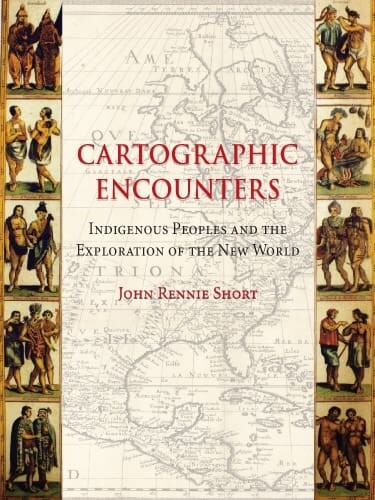
Cartographic Encounters
Indigenous Peoples and the Exploration of the New World
John Rennie ShortA re-interpretation of American history. It argues that both writing about and popular understanding of, the exploration and mapping of the New World has largely ignored the pivotal role played by indigenous people.
In this major re-interpretation of American history, John Rennie Short argues that until now, both writing about and popular understanding of, the exploration and mapping of the New World has largely ignored the pivotal role played by indigenous people. European mapping of the New World was the product of an exchange of information, a ‘cartographic encounter’ between newcomers and indigenous peoples. This encounter allowed Native Americans to parlay their deeper and wider knowledge of the land into a strong bargaining position, but in this very exchange lay the roots of the ultimate loss of their land.
Based on extensive research, Cartographic Encounters will appeal to a general readership, specialists and students in the field of cartography, and those interested in the history of indigenous peoples. Both readable and considered, this new account of America’s exploration will also force a radical change in how we view Western exploration and discovery in general.
A re-interpretation of American history. It argues that both writing about and popular understanding of, the exploration and mapping of the New World has largely ignored the pivotal role played by indigenous people.
In this major re-interpretation of American history, John Rennie Short argues that until now, both writing about and popular understanding of, the exploration and mapping of the New World has largely ignored the pivotal role played by indigenous people. European mapping of the New World was the product of an exchange of information, a ‘cartographic encounter’ between newcomers and indigenous peoples. This encounter allowed Native Americans to parlay their deeper and wider knowledge of the land into a strong bargaining position, but in this very exchange lay the roots of the ultimate loss of their land.
Based on extensive research, Cartographic Encounters will appeal to a general readership, specialists and students in the field of cartography, and those interested in the history of indigenous peoples. Both readable and considered, this new account of America’s exploration will also force a radical change in how we view Western exploration and discovery in general.
-
'
John Rennie Short has trawled through many dusty travel journals and pored over his share of early maps in order to reconstruct this fascinating cultural collision. His book ranges widely, from the cartographic artefacts of pre-Columbian civilisation (maps insribed on birch bark or carved into walrus tusks) to the 19th century exploration of Australia's interior . . . consistently entertaining and even-handed.
'Geographical Magazine
-
'
While based on obvious deep scholarship, the book retains a flowing conversational style that is accessible to all, thereby rendering its notions even more powerful and potentially far-reaching. It is, in short, a delight to read . . . richly illustrated and attractively produced . . . Cartographic Encounters succeeds in what it has set out to accomplish, and not only positions discovery and exploration within critical historiography but awakens as well our sense of justice and long-overdue attribution.
'The Globe
-
'
This is a book of maps and voyage appropriately available to a wide readership. Forty-nine illustrations, including early maps, persons, and scenes, meld with references, bibliography, and index to educate and entertain those interested in understanding something of the cartographic history that evolved twixt natives and European colonists in the New World. Recommended.
'Choice
-
'
This short, richly illustrated book describes the historically undervalued role that natives played in providing geographical intelligence to U.S. colonizers . . . a popular, accessible introduction to an often-overlooked issue.
'Journal of Interdisciplinary History
Part One: Introduction
1 Creation Myths and Cartographic Encounters
2 Amerindian Mappings
Part Two: Colonial Cartographies
3 Encounters in a Settled Land
4 Landing in a Strange Land
Part Three: Imperial Cartographies
5 Surveying the West: Lewis and Clark…and Others
6 Expedition into the 'Desert'
7 Fremont and Tah-Kai-Buhl
8 'Warren's Map'
9 Closing the Frontier in the West
Part Four: Conclusions
10 Cartographic Encounters in Australia
11 Journey's End
Appendix: Composite Journeys
References
Bibliography
Acknowledgements
Photographic Acknowledgements
Index
John Rennie Short is Emeritus Professor at the School of Public Policy, University of Maryland, Baltimore County. His many books include The Urban Now: Living in an Age of Global Urbanism (2023).