Beastly London
A History of Animals in the City
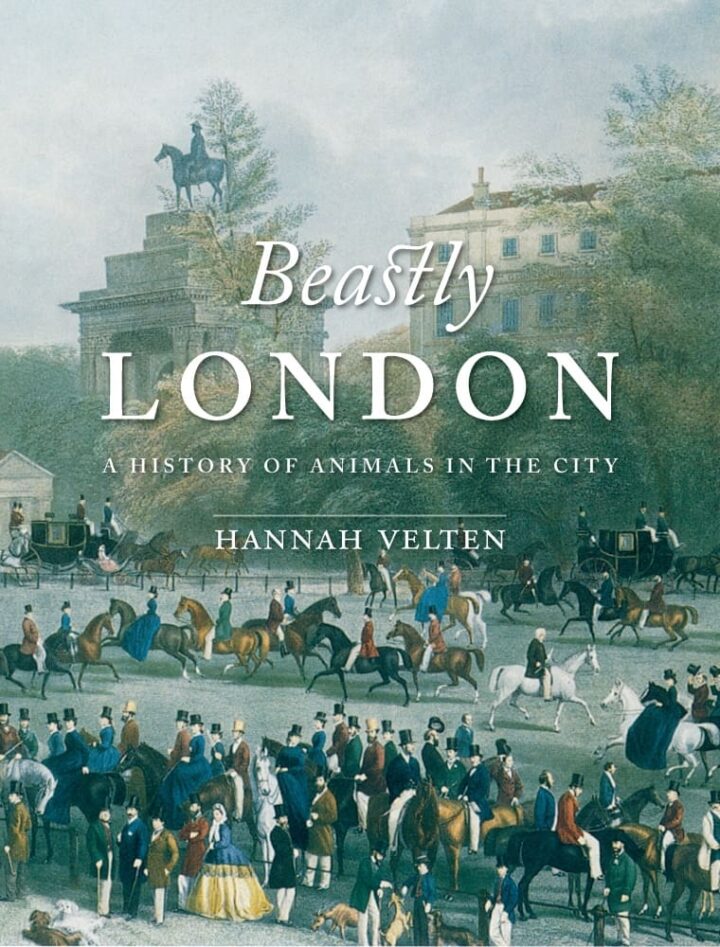
Hannah VeltenVirtually every street in London was once filled with a cacophony of animal calls and noises. From cattle being herded through the streets surrounding Smithfield meat market, to the exotic residents of the Tower of London zoo.
Infested by pests, vermin and bedbugs, Londoner’s homes were also shared with pets or livestock, which were reared for food. Beasts from far-flung corners of the globe were imported through London’s docks for display in all manner of establishments, from private homes and estates, to zoos and parks. Londoners were entertained by ponies flying in hot air balloons, performing fleas, any number of animals baited by dogs and the ubiquitous horse, which plied the streets as an essential cog in the machine of London’s industry and transport. Over the last 30 years, however, Londoners have seemingly banished animals from their streets.
Using a wide range of primary sources Beastly London explores the complex and changing relationship between Londoners of all classes and their animal neighbours: from a mainly exploitative relationship, to London becoming the birthplace of animal welfare societies and animal rights’ campaigns. This appealing book, now available in paperback, shows how London’s animals have been central to its success, and will appeal to all those interested in animal history and welfare.
Virtually every street in London was once filled with a cacophony of animal calls and noises. From cattle being herded through the streets surrounding Smithfield meat market, to the exotic residents of the Tower of London zoo.
Infested by pests, vermin and bedbugs, Londoner’s homes were also shared with pets or livestock, which were reared for food. Beasts from far-flung corners of the globe were imported through London’s docks for display in all manner of establishments, from private homes and estates, to zoos and parks. Londoners were entertained by ponies flying in hot air balloons, performing fleas, any number of animals baited by dogs and the ubiquitous horse, which plied the streets as an essential cog in the machine of London’s industry and transport. Over the last 30 years, however, Londoners have seemingly banished animals from their streets.
Using a wide range of primary sources Beastly London explores the complex and changing relationship between Londoners of all classes and their animal neighbours: from a mainly exploitative relationship, to London becoming the birthplace of animal welfare societies and animal rights’ campaigns. This appealing book, now available in paperback, shows how London’s animals have been central to its success, and will appeal to all those interested in animal history and welfare.
Virtually every street in London was once filled with a cacophony of animal calls and noises. From cattle being herded through the streets surrounding Smithfield meat market, to the exotic residents of the Tower of London zoo.
Infested by pests, vermin and bedbugs, Londoner’s homes were also shared with pets or livestock, which were reared for food. Beasts from far-flung corners of the globe were imported through London’s docks for display in all manner of establishments, from private homes and estates, to zoos and parks. Londoners were entertained by ponies flying in hot air balloons, performing fleas, any number of animals baited by dogs and the ubiquitous horse, which plied the streets as an essential cog in the machine of London’s industry and transport. Over the last 30 years, however, Londoners have seemingly banished animals from their streets.
Using a wide range of primary sources Beastly London explores the complex and changing relationship between Londoners of all classes and their animal neighbours: from a mainly exploitative relationship, to London becoming the birthplace of animal welfare societies and animal rights’ campaigns. This appealing book, now available in paperback, shows how London’s animals have been central to its success, and will appeal to all those interested in animal history and welfare.
-
'
Velten’s sumptuously illustrated, well-researched history of the city is a comprehensive and accessible account of changing and complex animal-human relationships . . . deeply absorbing.
'History Today
-
'
Hannah Velten’s lively account, which draws upon famous chroniclers of London life including Pepys and Dickens, as well as period prints, paintings and photographs, explores the hidden life of animals in the city. Like many histories, it’s colourful, but shot through with brutality. Beasts of burden were not always treated well by their owners, and for centuries bloodsports such as bear baiting and cockfights provided vulgar but robust entertainment. Performing animals probably had a happier life. Among her cast of theatrical creatures Velten introduces Toby the Sapient Pig, who could pick up letters written on cards and rearrange them into words, and a Chien Savant, who knew the Greek alphabet.
'World of Interiors
-
'
well researched, it is written in a popular style. It covers animal life from a variety of angles . . . beautifully produced and packed with a variety of well-chosen images, ranging from lithographs and photographs to paintings and cartoons.
'TLS
-
'
Many fascinating issues are explored, debated, and adroitly contextualized by Hannah Velten in Beastly London . . . Velten does well by allowing her sources to speak for themselves, as she provides a voice for her inarticulate subjects. She does so in a way that facilitates seamless transitions through time and between species. Readers are sure to be impressed by the countless visual sources ranging from 17th-century paintings to contemporary photos. These visuals adorn nearly every page and are not in place simply for the sake of aesthetics . . . Velten is at her best when she brings to life the stories of the individuals whose lives were intimately entwined with the city’s nonhuman animals.
'Journal of Animal Ethics
-
'
With every chapter indeed, with every turn of the page Beastly London presents the reader with such a vivid and detailed portrait of the natural history of the city’s animal life, both wild and domestic, as well as the activities of the human population that made their livings with or from them in a truly remarkable variety of ways that ranged from the mundane to the astonishingly curious, that it is extraordinarily difficult to put down . . . a superb book . . . it will do yeoman’s service indeed as a reference volume and should thus be included in the permanent library of not only naturalists and natural historians but general historians as well. Indeed, anyone with an interest in urban development, sociology, and particularly English literature should consider their own libraries incomplete without a copy of Beastly London readily available on the shelves.
'The Well-Read Naturalist
-
'
Velten has a lovely way of writing and her sensitivity to the plight of animals is clear, but never obstructs from detail . . . Velten weaves the words of Pepys, Defoe, Evelyn, Dickens and Hogarth and other witnesses from history into her narrative all of which is accompanied by an fantastic assemblage of carefully chosen images. In short, Velten does for London’s animal history what Ackroyd did for its human history. From the cattle herded through the streets surrounding Smithfield’s Market, and the work-weary cart, dray and coal horses, to the exotic but doomed animals holding residency at the Tower of London, and the pests, vermin and bedbugs in Londoners own homes for most animals the capital was a living hell. Beastly London goes some way to repaying the great debt we owe them for not only shaping the city, but transforming everyday life.
'The History Vault
-
'
From fleas to elephants, this book has it covered . . . an entertaining and deeply absorbing examination of the life of animals in our city . . . This is simply an outstanding book.
'London Historians
Introduction: Revealing the Beasts
1 Livestock: Londoners’ Nuisance Neighbours
2 Working Animals: Straining Every Muscle
3 Sporting Animals: Natural Instincts Exploited
4 Animals as Entertainers: Performance, Peculiarity and Pressure
5 Exotic Animals: The Allure of the Foreign and the Wild
6 Pampered Pets and Sad Strays
7 London Wildlife: The Persecuted and the Celebrated
Final Thoughts: An Apology and a Pardon
References
Acknowledgements
Photo Acknowledgements
Index
Hannah Velten is a freelance writer who has worked extensively with cows and oxen on Australian cattle stations and British dairy farms. She lives in Fletching, Sussex, and is the the author of Cow (Animal series, 2007) and Milk (Edible series, 2010), both published by Reaktion Books.