


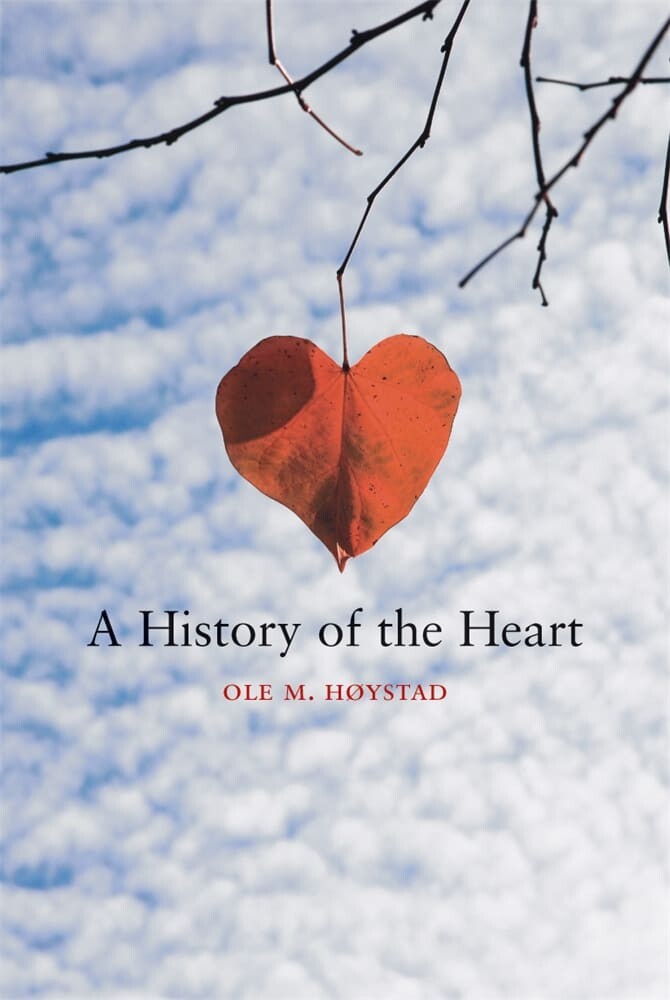
A History of the Heart
Ole M. HøystadCharts how the heart has signified our essential desires, whether for love and passion in the medieval excesses of troubadour poetry and chivalric idealism, the body-soul dualism propounded by the Enlightenment, or even the modern notions of individualism expressed in the works of thinkers such as Nietzsche and Foucault.
The heart not only drives our physical life, but throughout human history it has also been viewed as the seat of our deepest emotions. It has figured hugely – if metaphorically – in nearly every aspect of human civilization, and as the unending subject of literature, music and art. Yet until now there has not been a study of this paramount icon of love. Ole M. Høystad ably fills this enormous gap with a compelling investigation into this epicentre of grief, joy and power.
Firmly positioning the heart at the metaphorical and literal centre of human culture and history, Høystad combs through religions and philosophies from the beginning of civilization to explore such disparate historical points as the Aztecs’ ritual of removing the still-beating heart from a living sacrificial victim and offering it to the gods; homosexuality and the heart in Greek antiquity; European attempts to employ alchemy in service of the mysteries of love; and the connections between the heart and wisdom in Sufism. Høystad charts how the heart has signified our essential desires, whether for love and passion in the medieval excesses of troubadour poetry and chivalric idealism, the body-soul dualism propounded by the Enlightenment, or even the modern notions of individualism expressed in the works of thinkers such as Nietzsche and Foucault.
A provocative examination of the deepest vaults of our souls and the efforts of the many lonely hunters who have tried to unlock its secrets, A History of the Heart subverts the clichés to reveal a symbol of our fundamental humanity whose beats can be felt in every aspect of our lives.
Charts how the heart has signified our essential desires, whether for love and passion in the medieval excesses of troubadour poetry and chivalric idealism, the body-soul dualism propounded by the Enlightenment, or even the modern notions of individualism expressed in the works of thinkers such as Nietzsche and Foucault.
The heart not only drives our physical life, but throughout human history it has also been viewed as the seat of our deepest emotions. It has figured hugely – if metaphorically – in nearly every aspect of human civilization, and as the unending subject of literature, music and art. Yet until now there has not been a study of this paramount icon of love. Ole M. Høystad ably fills this enormous gap with a compelling investigation into this epicentre of grief, joy and power.
Firmly positioning the heart at the metaphorical and literal centre of human culture and history, Høystad combs through religions and philosophies from the beginning of civilization to explore such disparate historical points as the Aztecs’ ritual of removing the still-beating heart from a living sacrificial victim and offering it to the gods; homosexuality and the heart in Greek antiquity; European attempts to employ alchemy in service of the mysteries of love; and the connections between the heart and wisdom in Sufism. Høystad charts how the heart has signified our essential desires, whether for love and passion in the medieval excesses of troubadour poetry and chivalric idealism, the body-soul dualism propounded by the Enlightenment, or even the modern notions of individualism expressed in the works of thinkers such as Nietzsche and Foucault.
A provocative examination of the deepest vaults of our souls and the efforts of the many lonely hunters who have tried to unlock its secrets, A History of the Heart subverts the clichés to reveal a symbol of our fundamental humanity whose beats can be felt in every aspect of our lives.
Charts how the heart has signified our essential desires, whether for love and passion in the medieval excesses of troubadour poetry and chivalric idealism, the body-soul dualism propounded by the Enlightenment, or even the modern notions of individualism expressed in the works of thinkers such as Nietzsche and Foucault.
The heart not only drives our physical life, but throughout human history it has also been viewed as the seat of our deepest emotions. It has figured hugely – if metaphorically – in nearly every aspect of human civilization, and as the unending subject of literature, music and art. Yet until now there has not been a study of this paramount icon of love. Ole M. Høystad ably fills this enormous gap with a compelling investigation into this epicentre of grief, joy and power.
Firmly positioning the heart at the metaphorical and literal centre of human culture and history, Høystad combs through religions and philosophies from the beginning of civilization to explore such disparate historical points as the Aztecs’ ritual of removing the still-beating heart from a living sacrificial victim and offering it to the gods; homosexuality and the heart in Greek antiquity; European attempts to employ alchemy in service of the mysteries of love; and the connections between the heart and wisdom in Sufism. Høystad charts how the heart has signified our essential desires, whether for love and passion in the medieval excesses of troubadour poetry and chivalric idealism, the body-soul dualism propounded by the Enlightenment, or even the modern notions of individualism expressed in the works of thinkers such as Nietzsche and Foucault.
A provocative examination of the deepest vaults of our souls and the efforts of the many lonely hunters who have tried to unlock its secrets, A History of the Heart subverts the clichés to reveal a symbol of our fundamental humanity whose beats can be felt in every aspect of our lives.
-
'
A History of the Heart is about far more than the changing representation of this most charismatic organ. Indeed, the ease with which the central storyline opens into a wide-ranging intellectual history of Western culture is the books chief delight and major achievement . . . beautifully presented.
'Times Higher Education Supplement
-
'
This is the first study of the representation of the human heart in English from the earliest writings to the present day, a hugely ambitious project which, employing a "history of mentalities" methodology, is also a provocative personal philosophical history of largely western concepts of life, the body, nature, ethics, language, culture and the self.
'Social History of Medicine
-
'
An entertaining, clearly-written and knowledgeable tour de force through European intellectual history.
'Süddeutsche Zeitung
-
'
Høystad brings us to the essence of mankind.
'Die Zeit
-
'
Høystad can play a linguistically subtle tune of scholarly brilliance.
'Neue Züricher Zeitung
-
'
Høystads work, which also explores areas as diverse as Christianity, Shakespeare, Nietzsche and open heart surgery, is a fascinating look at perhaps the worlds most important symbol.
'Suite 101.com
-
'
August 2007: John Irons, translator of A History of the Heart and A Philosophy of Boredom has been awarded the prestigious NORLA prize. For details please click here
'Quote
Preface
INTRODUCTION
THE HEART IN DIFFERENT CULTURES
The oldest of high civilizations – Sumer and Gilgamesh
The mythical heart in ancient Egyptian culture
Anthropology
The many-sided human being of Greek antiquity
Mankind in Homer
Laughter and passion
The Dionysian and the Apollonian
Homosexuality in antiquity
The Platonic human image
From Aristotle to Galen
The history of Plato’s legacy
The heart in the Bible and in Christianity
The Old Testament
The New Testament
Paul
Augustine
Augustine’s legacy and the Middle Ages
The greatest and most beautiful European creation?
Islam – last surviving heart culture?
The wisdom of the heart and the heart of wisdom in Sufism
Arabian influences on European culture
Aztecs – Why so heartless?
I am fat, even at the heart-roots – Norse anthropology
THE EMERGENCE OF THE MODERN EUROPEAN – THE CONFLICT ABOUT THE HEART
The emotional turn in the High Middle Ages
Troubadour poetry
Novels of chivalry
Eroticism and religion: Abélard og Héloïse
The heart in romantic love
Tales of everyday love
The new subject
Descartes and the body-soul dualism
Montaigne: Man is his work
The body of the text and the text of the body
Eros and Thanatos: Ars moriendi
From Renaissance and alchemy to Romanticism
Shakespeare the heartbreaker
”I cannot heave my heart into my mouth”
Rousseau – philosopher of the heart
Herder and the expressive turn
The Faustian Goethe
Long live individualism! From Nietzsche to Foucault and Campbell
POSTSCRIPT: THE CIRCULATORY SYSTEM OF THE EMOTIONS
BIBLIOGRAPHY
NAME REGISTER
Ole M. Høystad is Professor of Cultural Studies at Telemark University College in Norway, and currently Visiting Professor of Cultural Studies and History at the University of Southern Denmark, Odense.