


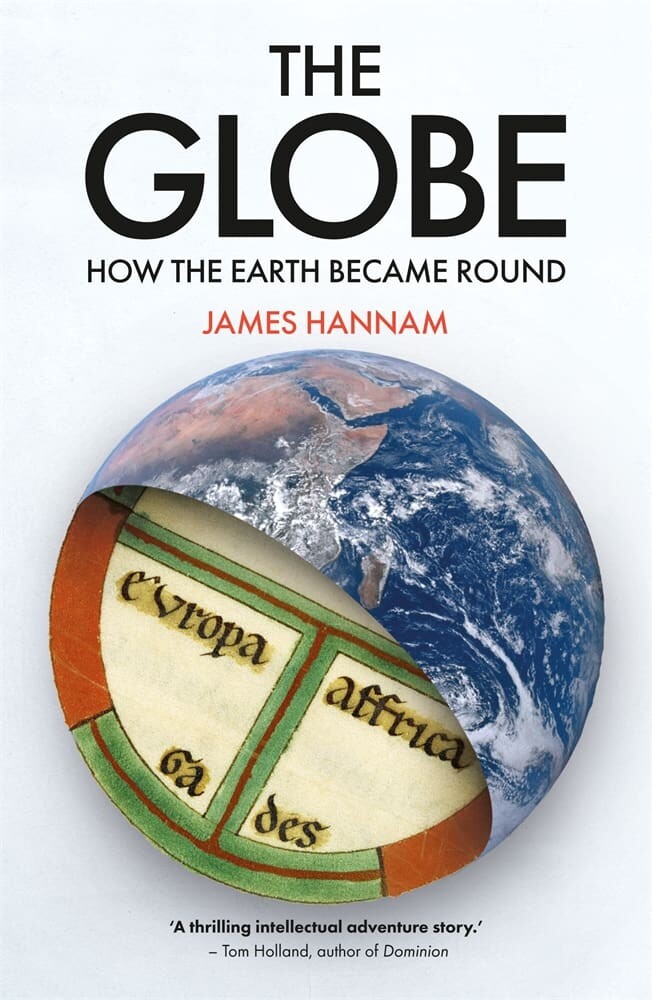
The Globe
How the Earth Became Round
James HannamA history of how we came to know that the earth is round, rather than flat.
Now in paperback, The Globe traces humanity’s quest to understand the true shape of the Earth. Ancient Greek philosophers identified it as spherical in the fourth century BCE, with this knowledge spreading via Rome, India, and Central Asia. The Catholic Church accepted a round Earth well before Columbus, yet Jesuit missionaries only persuaded the Chinese to abandon their square-earth cosmology in the seventeenth century. Challenging traditional views on intellectual history, The Globe argues that recognising Earth’s spherical nature was humanity’s first major scientific breakthrough. Compelling and thought-provoking, the book explores how this discovery reshaped global perspectives across centuries.
A history of how we came to know that the earth is round, rather than flat.
Now in paperback, The Globe traces humanity’s quest to understand the true shape of the Earth. Ancient Greek philosophers identified it as spherical in the fourth century BCE, with this knowledge spreading via Rome, India, and Central Asia. The Catholic Church accepted a round Earth well before Columbus, yet Jesuit missionaries only persuaded the Chinese to abandon their square-earth cosmology in the seventeenth century. Challenging traditional views on intellectual history, The Globe argues that recognising Earth’s spherical nature was humanity’s first major scientific breakthrough. Compelling and thought-provoking, the book explores how this discovery reshaped global perspectives across centuries.
A history of how we came to know that the earth is round, rather than flat.
Now in paperback, The Globe traces humanity’s quest to understand the true shape of the Earth. Ancient Greek philosophers identified it as spherical in the fourth century BCE, with this knowledge spreading via Rome, India, and Central Asia. The Catholic Church accepted a round Earth well before Columbus, yet Jesuit missionaries only persuaded the Chinese to abandon their square-earth cosmology in the seventeenth century. Challenging traditional views on intellectual history, The Globe argues that recognising Earth’s spherical nature was humanity’s first major scientific breakthrough. Compelling and thought-provoking, the book explores how this discovery reshaped global perspectives across centuries.
-
'
Hannam gives us context and biography, when available . . . The virtue of Hannam’s writing style is that it is almost invisible. The reader does not have to untangle sentences, as often in academic prose, nor does the author plant the meadows of his pages with rare and distracting lexicographic blooms. As for the arc of his history, it swept me along, especially when I found I was learning a thing or two . . . Bede called Pliny’s Natural History – “that delightful book” – and the same could be said of Hannam’s own lively historical journey.”
'The Daily Telegraph
-
'
Give the gift of science . . . James Hannam’s The Globe celebrates our first great scientific achievement: realising, thousands of years ago and against all intuition, that Earth is a a ball floating in space.
'New Scientist, ‘Best Non-Fiction and Popular Science Books of 2023'
-
'
This splendid book . . . aims mainly to dismantle 'the conflict theory' – the idea that a battle between science and religious literalism prevented people accepting the roundness of the Earth well into the 15th century . . . After a colourful tour through ancient Babylonian, Egyptian and Persian cosmologies, we arrive at the Greeks, who at last began to figure things out.
'The Spectator
-
'
The story of what James Hannam calls "humanity's first great scientific achievement" is more complicated – and interesting – than you might have imagined. Through 23 chapters packed with compelling personalities, Hannam whizzes us around the globe between historical conceptions of our planet, from ancient Mesopotamia (a round disc) via ancient China (a square set in a spherical heaven) to our modern oblate spheroid . . . He brings to thrilling life centuries of intense debate and disagreement – the fertile ground on which science grows.
'BBC History
-
'
James Hannam’s The Globe takes us on a whirlwind 2,000-year tour d’horizon of how the counter-intuitive theory of a round world became accepted as scientific fact . . . Hannam has been able to encapsulate such a wide range of historical sources into an enjoyable, fast-paced narrative. Those whose scholarly appetites have been whetted can consult the comprehensive and well-chosen bibliography for follow-up reading . . . [The Globe is] a rollicking scientific-historical adventure.
'The Critic
-
'
This fascinating chronicle by historian Hannam traces how humanity’s understanding of Earth’s shape has changed over millennia . . . The trivia captivates (the prevailing view under China’s Han dynasty claimed "the sky was round and the Earth was square"), offering a globe-trotting tour of how a major scientific breakthrough made its way across the world. Readers will be enlightened.
'Publishers Weekly
-
'
From the philosophers of ancient Greece to seventh-century Jesuit missionaries to China, the story of humanity’s quest to discover the form of our world, and how we came to know that the Earth is round and not flat.
'The Bookseller
-
'
From philosophers in ancient Greece to Jesuit missionaries in China, James Hannam’s The Globe explores the history of ideas and our quest to understand our planet.
'People's Friend: 'We're Loving'
-
'
A tour d’horizon that spans time as well as space, this is a thrilling intellectual adventure story.
'Tom Holland, author of Dominion: The Making of the Western Mind
-
'
In an age of globalisation, James Hannam’s playful and erudite book reminds us of the global origins of our common understanding of the spherical earth, stretching from Babylon to NASA. A truly all-encompassing book: a wonderful achievement and a delight to read.
'Jerry Brotton, author of A History of the World in Twelve Maps
-
'
An exploration of one of humankind’s oldest and most profound insights, The Globe is a work of compulsively readable myth-busting. As amiable as it is scholarly, James Hannam’s book uses the history of the spherical Earth to provide a global tour of cosmologies through the ages.
'Philip Ball, author of The Book of Minds
Introduction: ‘The Blue Marble’
1 Babylon: ‘The four quarters of the Earth’
2 Egypt: ‘The black loam and the red sand’
3 Persia: ‘Order and Deceit’
4 Archaic Greece: ‘The Shield of Achilles’
5 The Origins of Greek Thought: ‘Equally distant from all extremes’
6 The Presocratics and Socrates: ‘Floating on air’
7 Plato: ‘Flat or round, whichever is better’
8 Aristotle: ‘Necessarily spherical’
9 Greek Debate on the Shape of the World: ‘Either round or triangular or some other shape’
10 Romans on the Globe: ‘The circle of the world’
11 India: ‘The mountain at the North Pole’
12 The Sassanian Persians: ‘Good thoughts, good words, good deeds’
13 Early Judaism: ‘From the ends of the Earth’
14 Christianity: ‘All things established by divine command’
15 Islam: ‘The Earth laid out like a carpet’
16 Later Judaism: ‘The wise men of the nations have defeated the wise men of Israel’
17 Europe in the Early Middle Ages: ‘Equally round in all directions’
18 High Medieval Views of the World: ‘The Earth has the shape of a globe’
19 Columbus and Copernicus: ‘New worlds will be found’
20 China: ‘The heavens are round and the Earth is square’
21 China and the West: ‘Like the yolk in a hen’s egg’
22 The Globe Goes Global: ‘At the round Earth’s imagined corners’
23 Today: ‘There’s nothing particularly exciting about a round world’
Afterword
References
Bibliography
Acknowledgements
Photo Acknowledgements
Index
James Hannam is the author of God’s Philosophers: How the Medieval World Laid the Foundations of Modern Science (2009). He is a fellow of the Royal Historical Society, and lives in Kent.