


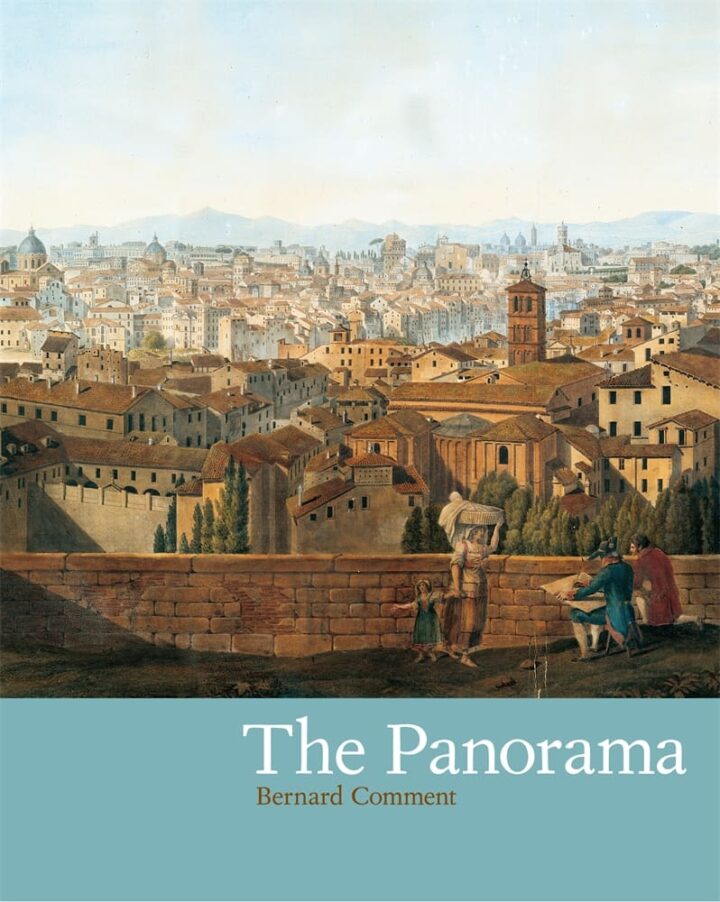
The Panorama
Bernard CommentInvented in 1788, the panorama reached the height of its popularity at the time of the 1900 Universal Exhibition. This illustrated text surveys a wide variety of examples from all over the world, examining the panorama from its invention to present day.
Invented in 1788, the panorama reached the height of its popularity at the time of the 1900 Universal Exhibition. Vast circular canvases installed in purpose-built rotundas were designed to be viewed from centrally placed platforms and attracted an admiring public. The aim was to produce a perfect illusion. Thus the relationship between viewer and ‘reality’ underwent a profound mutation, opening up a new logic according to which the world was transformed into a spectacle and images substituted for direct experience.
This lavishly illustrated book examines the wide variety of panoramas in both the Old and New Worlds. Included among views of cities are Robert Barker’s View of Edinburgh and Karl Friedrich Schinkel’s View of Palermo, as well as depiction of Paris, Moscow, Jerusalem and Lima; among historical themes, The History of the Century and Battle of Moscow proved especially popular. The author expands his subject to encompass the sister formats of diorama and cineorama.
Invented in 1788, the panorama reached the height of its popularity at the time of the 1900 Universal Exhibition. This illustrated text surveys a wide variety of examples from all over the world, examining the panorama from its invention to present day.
Invented in 1788, the panorama reached the height of its popularity at the time of the 1900 Universal Exhibition. Vast circular canvases installed in purpose-built rotundas were designed to be viewed from centrally placed platforms and attracted an admiring public. The aim was to produce a perfect illusion. Thus the relationship between viewer and ‘reality’ underwent a profound mutation, opening up a new logic according to which the world was transformed into a spectacle and images substituted for direct experience.
This lavishly illustrated book examines the wide variety of panoramas in both the Old and New Worlds. Included among views of cities are Robert Barker’s View of Edinburgh and Karl Friedrich Schinkel’s View of Palermo, as well as depiction of Paris, Moscow, Jerusalem and Lima; among historical themes, The History of the Century and Battle of Moscow proved especially popular. The author expands his subject to encompass the sister formats of diorama and cineorama.
Bernard Comment, born in Switzerland, lives and works in Paris. He is the author of L'ombre de mémoire (1990), Roland Barthes, vers le neuter (1991) and Allées et venues (1992), which won the Prix Antigone in 1993.