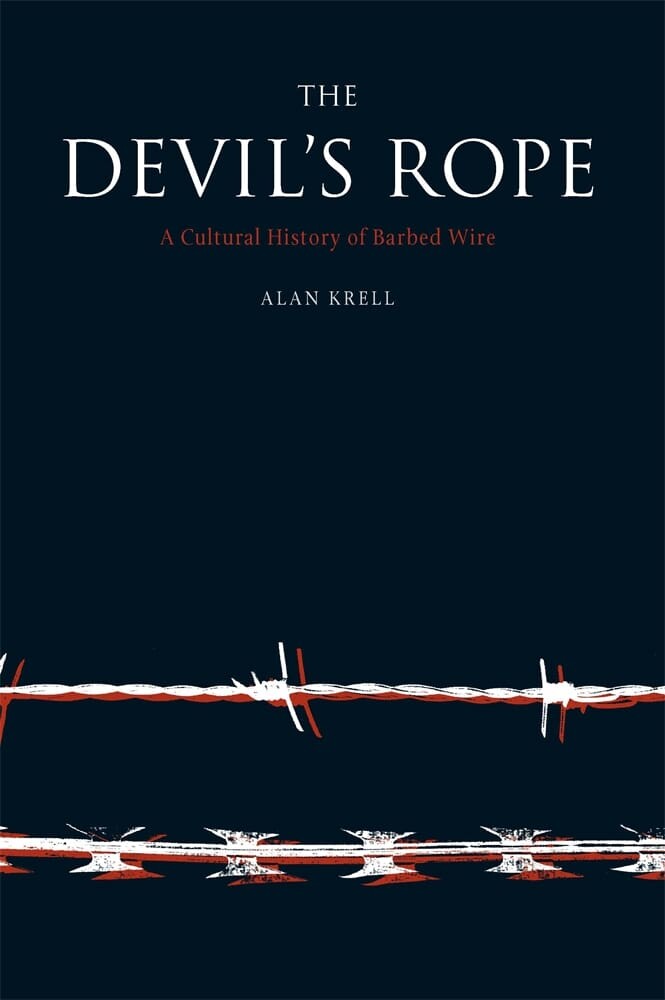
The Devil’s Rope
A Cultural History of Barbed Wire
Alan KrellBarbed wire, as a tool of control, has played a critical role in the modern experience. It also has another history constructed through image and text in the arts, media and popular culture. This work critically examines these representations.
Barbed wire cuts across more than just property, war and politics. This most vicious tool of control has played a critical role in the modern experience, be it territorial expansion or the settlement of local and international conflicts. However, it has other histories: those constructed through image and text in the arts, media and popular culture. These representations – in painting, photography, poetry, personal memoirs, cartoons, novels, advertisements and film – have never before been critically examined. In this book, Alan Krell investigates the place barbed wire holds in the social imagination.
Invented in France in 1860, barbed wire was developed independently in the USA, where it was used to control livestock on the Great Plains, both to ‘keep out’ and ‘keep in’. Promoted as the Ideal Fence, barbed wire’s menacing qualities were soon made manifest. The epithet, ‘The Devil’s Rope’, anticipated its transformation into a tool of war in the late nineteenthth and early twentieth century. Henceforth, it would become synonymous with repression. Barbed wire’s conflicting character makes it an appropriate symbol of modernity, and Krell shows how the use of this symbolism in contemporary art has given barbed wire meanings beyond the historical and political realms.
Barbed wire, as a tool of control, has played a critical role in the modern experience. It also has another history constructed through image and text in the arts, media and popular culture. This work critically examines these representations.
Barbed wire cuts across more than just property, war and politics. This most vicious tool of control has played a critical role in the modern experience, be it territorial expansion or the settlement of local and international conflicts. However, it has other histories: those constructed through image and text in the arts, media and popular culture. These representations – in painting, photography, poetry, personal memoirs, cartoons, novels, advertisements and film – have never before been critically examined. In this book, Alan Krell investigates the place barbed wire holds in the social imagination.
Invented in France in 1860, barbed wire was developed independently in the USA, where it was used to control livestock on the Great Plains, both to ‘keep out’ and ‘keep in’. Promoted as the Ideal Fence, barbed wire’s menacing qualities were soon made manifest. The epithet, ‘The Devil’s Rope’, anticipated its transformation into a tool of war in the late nineteenthth and early twentieth century. Henceforth, it would become synonymous with repression. Barbed wire’s conflicting character makes it an appropriate symbol of modernity, and Krell shows how the use of this symbolism in contemporary art has given barbed wire meanings beyond the historical and political realms.
-
'
Richly illustrated . . . His prose purrs like a Formula One engine and the enthusiasm evident on every page almost tempted me to take out a subscription to The Barbed Wire Times. Yes, such publications do exist.
'Times Higher Education
-
'
fascinating insights into a simple invention that has carved up the modern world in the most complex of ways.
'The Irish Times
-
'
fascinating
'The Historian
Preface: Looking through the Wire
1. The devil's in the detail
2. Tortured bodies/touching sites
3. Making familiar
4. Entangled intimacies
5. Grasping the nettle
Postscript
References
Bibliography
Acknowledgements
Photographic Acknowledgements
Index
Alan Krell was recently Associate Professor in Art History at UNSW Art and Design, Sydney, where he worked for over two decades. He now lives in London. His books include Manet and the Painters of Contemporary Life (1996), The Devil’s Rope: A Cultural History of Barbed Wire (Reaktion, 2002) and Burning Issues: Fire in Art and the Social Imagination (Reaktion, 2011).