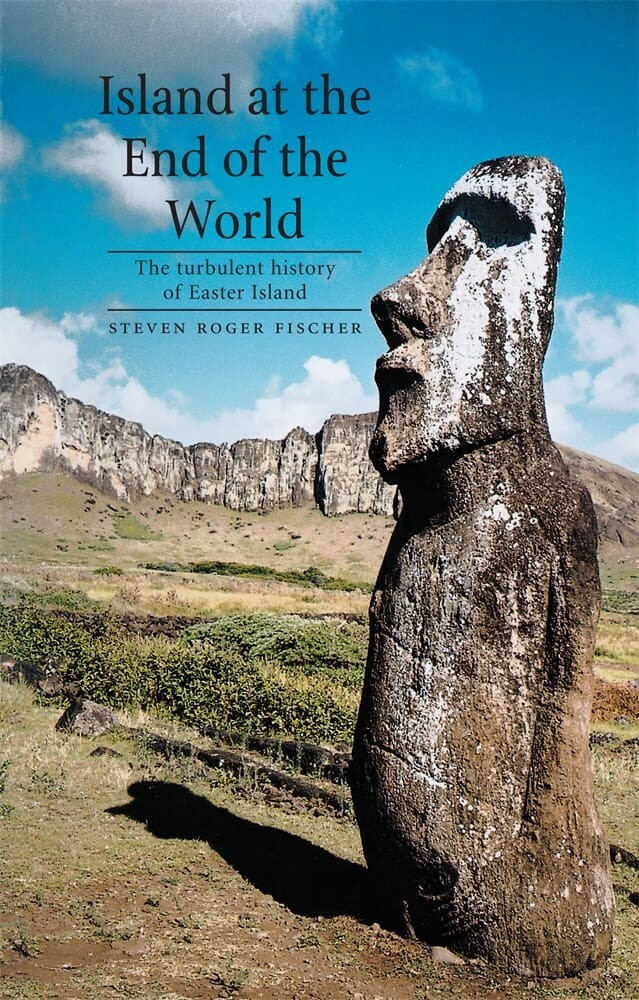
Island at the End of the World
The Turbulent History of Easter Island
Steven Roger FischerFamed for its breathtaking isolation, Easter Island was a verdant South-Sea idyll when a small canoeful of Polynesians arrived in c AD 700. Centuries later the island's statues were famous throughout the world. This book presents a comprehensive history of Easter Island, its people and their extraordinary story.
Famed for its breathtaking isolation, Easter Island was a verdant South-Sea idyll when a small canoeful of Polynesians arrived in c. AD 700. Centuries later the island's statues were famous throughout the world. This book presents a comprehensive history of Easter Island told by a writer who is intimately familiar with the island, its people and their extraordinary story.
When voyaging in the South Pacific became far less widespread around 1500, Easter Islanders became stranded on their desert-like isle, and were forced to adapt to survive. The first European visitors, in 1722, encountered a people thriving in total isolation, surrounded by huge architectural platforms of fitted stones topped by hundreds of monolithic busts. Subsequent intruders brought trade, disease, violence, and the Easter Islanders adapted to this change, too, through cultural re-invention: new leaders, new rituals, new gods. Steven Roger Fischer relates the compelling history of this unique region: how wars, smallpox and the Great Death decimated the island, how Catholic missionaries arrived in 1866 to relieve the suffering of the dying people, and how a despotic Frenchman claimed the island for himself, but who was then killed by the remaining islanders – a population of only 111.
The author also examines the modern history of the island, its colonization and annexation by Chile, and its peaceful but insistent civil rights movement in 1964-65. Today, the population has increased, as has tourism of the island – from 2,000 visitors in 1991 to 20,000 in 2001 – and continues to be managed by the indigenous Rapanui people. Foreign interest in Easter Island has never been so keen, and this book is a much-needed history of this little-known but remarkable island.
Famed for its breathtaking isolation, Easter Island was a verdant South-Sea idyll when a small canoeful of Polynesians arrived in c AD 700. Centuries later the island's statues were famous throughout the world. This book presents a comprehensive history of Easter Island, its people and their extraordinary story.
Famed for its breathtaking isolation, Easter Island was a verdant South-Sea idyll when a small canoeful of Polynesians arrived in c. AD 700. Centuries later the island's statues were famous throughout the world. This book presents a comprehensive history of Easter Island told by a writer who is intimately familiar with the island, its people and their extraordinary story.
When voyaging in the South Pacific became far less widespread around 1500, Easter Islanders became stranded on their desert-like isle, and were forced to adapt to survive. The first European visitors, in 1722, encountered a people thriving in total isolation, surrounded by huge architectural platforms of fitted stones topped by hundreds of monolithic busts. Subsequent intruders brought trade, disease, violence, and the Easter Islanders adapted to this change, too, through cultural re-invention: new leaders, new rituals, new gods. Steven Roger Fischer relates the compelling history of this unique region: how wars, smallpox and the Great Death decimated the island, how Catholic missionaries arrived in 1866 to relieve the suffering of the dying people, and how a despotic Frenchman claimed the island for himself, but who was then killed by the remaining islanders – a population of only 111.
The author also examines the modern history of the island, its colonization and annexation by Chile, and its peaceful but insistent civil rights movement in 1964-65. Today, the population has increased, as has tourism of the island – from 2,000 visitors in 1991 to 20,000 in 2001 – and continues to be managed by the indigenous Rapanui people. Foreign interest in Easter Island has never been so keen, and this book is a much-needed history of this little-known but remarkable island.
Famed for its breathtaking isolation, Easter Island was a verdant South-Sea idyll when a small canoeful of Polynesians arrived in c AD 700. Centuries later the island's statues were famous throughout the world. This book presents a comprehensive history of Easter Island, its people and their extraordinary story.
Famed for its breathtaking isolation, Easter Island was a verdant South-Sea idyll when a small canoeful of Polynesians arrived in c. AD 700. Centuries later the island's statues were famous throughout the world. This book presents a comprehensive history of Easter Island told by a writer who is intimately familiar with the island, its people and their extraordinary story.
When voyaging in the South Pacific became far less widespread around 1500, Easter Islanders became stranded on their desert-like isle, and were forced to adapt to survive. The first European visitors, in 1722, encountered a people thriving in total isolation, surrounded by huge architectural platforms of fitted stones topped by hundreds of monolithic busts. Subsequent intruders brought trade, disease, violence, and the Easter Islanders adapted to this change, too, through cultural re-invention: new leaders, new rituals, new gods. Steven Roger Fischer relates the compelling history of this unique region: how wars, smallpox and the Great Death decimated the island, how Catholic missionaries arrived in 1866 to relieve the suffering of the dying people, and how a despotic Frenchman claimed the island for himself, but who was then killed by the remaining islanders – a population of only 111.
The author also examines the modern history of the island, its colonization and annexation by Chile, and its peaceful but insistent civil rights movement in 1964-65. Today, the population has increased, as has tourism of the island – from 2,000 visitors in 1991 to 20,000 in 2001 – and continues to be managed by the indigenous Rapanui people. Foreign interest in Easter Island has never been so keen, and this book is a much-needed history of this little-known but remarkable island.
-
'
a fascinating and highly readable history of one of the most exotic islands on earth.
'The Economist
-
'
There is a moving drama in [Fischer's] charting of a remarkable community that has lost its cultural identity and faces a uniquely challenging future.
'Daily Telegraph
-
'
Steven Roger Fischer's exhaustive study . . . touches all the bases.
'Geographical Magazine
-
'
unlocks not only the mystery of the island but also its people and their extraordinary history.
'Graduate Journal of Asia-Pacific Studies
Introduction
1. The Polynesian Frontier
2. White Men and Birdmen
3. Pirates and Priests
4. Rancho Isla de Pascua
5. Museum Island
References
Bibliography
Acknowledgments
Photographic Acknowledgments
Index
Steven Roger Fischer FRS is the author of many popular books including A History of Language (1999) and A History of Writing (2001), both published by Reaktion.