


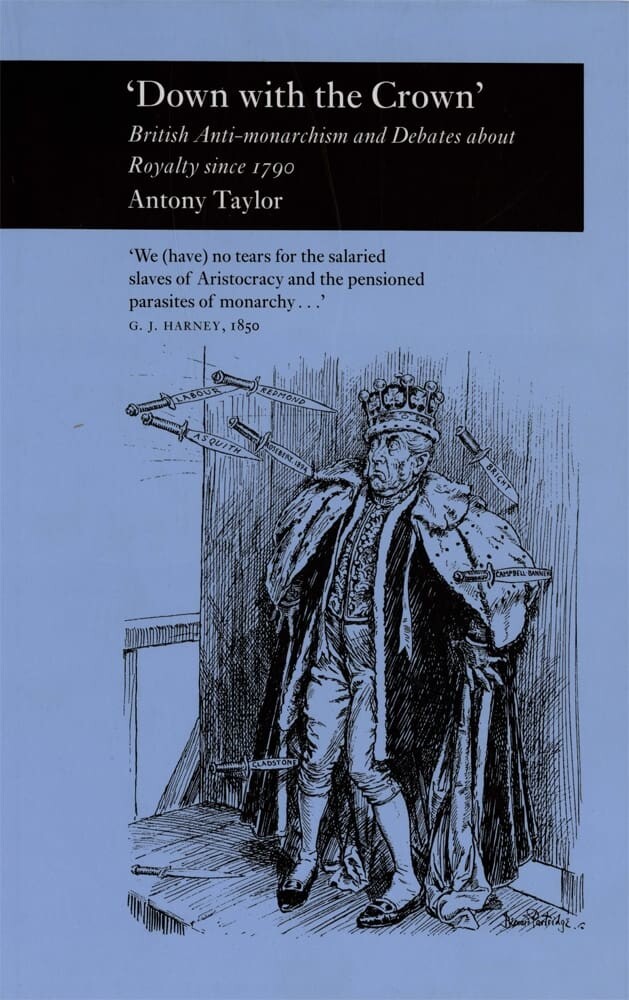
‘Down with the Crown’
British Anti-monarchism and Debates about Royalty since 1790
Antony TaylorIn recent years, discontent with the monarchy has regularly made itself felt in both Britain and the Commonwealth. Whilst a number of important studies have scrutinized the pomp and circumstance surrounding the British royal family, radical opposing tendencies – the tradition of anti-monarchism – have been neglected. For some historians, this current of English republicanism has simply never existed.
Beginning his controversial book with the reign of George III and ending with the death of Diana, Princess of Wales, Antony Taylor argues that in fact debates about royalty in Britain have always included an anti-monarchist element.
At a moment when political issues of key importance to Britain’s future – European integration, the social and economic ramifications of Labour’s election victory, devolution in Scotland and Wales, the monarchy’s private woes vs. their public face, reform of the House of Lords – are forcing members of the public and politicians alike to take a long, hard look at their governing institutions, Taylor’s lively study is particularly timely. Touching on the historical antecedents to the present crises, his book reconsiders English notions of republicanism, the Cromwellian legacy of the radical politics of the nineteenth-century reform movement, radicalism’s relationship with Liberalism, and the hostility of reformers to the House of Lords. It also surveys republican traditions in the former colonies, with special attention paid to Australia. A significant contribution to the debate on the present crisis in the House of Windsor, ‘Down with the Crown’ seeks to modify widely held assumptions about the historical failure of radicals to contest monarchy in an effective and lasting manner.
In recent years, discontent with the monarchy has regularly made itself felt in both Britain and the Commonwealth. Whilst a number of important studies have scrutinized the pomp and circumstance surrounding the British royal family, radical opposing tendencies – the tradition of anti-monarchism – have been neglected. For some historians, this current of English republicanism has simply never existed.
Beginning his controversial book with the reign of George III and ending with the death of Diana, Princess of Wales, Antony Taylor argues that in fact debates about royalty in Britain have always included an anti-monarchist element.
At a moment when political issues of key importance to Britain’s future – European integration, the social and economic ramifications of Labour’s election victory, devolution in Scotland and Wales, the monarchy’s private woes vs. their public face, reform of the House of Lords – are forcing members of the public and politicians alike to take a long, hard look at their governing institutions, Taylor’s lively study is particularly timely. Touching on the historical antecedents to the present crises, his book reconsiders English notions of republicanism, the Cromwellian legacy of the radical politics of the nineteenth-century reform movement, radicalism’s relationship with Liberalism, and the hostility of reformers to the House of Lords. It also surveys republican traditions in the former colonies, with special attention paid to Australia. A significant contribution to the debate on the present crisis in the House of Windsor, ‘Down with the Crown’ seeks to modify widely held assumptions about the historical failure of radicals to contest monarchy in an effective and lasting manner.
Antony Taylor is Professor of Modern British History at Sheffield Hallam University. He has published widely in the field of nineteenth-century British history.