Extinct
A Compendium of Obsolete Objects
Barbara Penner, Adrian FortyA collection of 85 ‘extinct’ objects, now superseded, unfashionable or simply forgotten
Extinct gathers together the work of an exceptional range of artists, curators, architects, critics and academics, including Barry Bergdoll, Gillian Darley, Tacita Dean, David Edgerton, Hal Foster, Catherine Slessor, Deyan Sudjic and Richard Wentworth. In 85 illustrated essays, contributors nominate ‘extinct’ objects and address them in a series of short, vivid, sometimes personal essays, speaking of not only obsolete technologies but other ways of thinking, making and interacting with the world. Extinct is filled with curious, half-remembered objects, each one evoking a future that never came to pass.
A collection of 85 ‘extinct’ objects, now superseded, unfashionable or simply forgotten
Extinct gathers together the work of an exceptional range of artists, curators, architects, critics and academics, including Barry Bergdoll, Gillian Darley, Tacita Dean, David Edgerton, Hal Foster, Catherine Slessor, Deyan Sudjic and Richard Wentworth. In 85 illustrated essays, contributors nominate ‘extinct’ objects and address them in a series of short, vivid, sometimes personal essays, speaking of not only obsolete technologies but other ways of thinking, making and interacting with the world. Extinct is filled with curious, half-remembered objects, each one evoking a future that never came to pass.
A collection of 85 ‘extinct’ objects, now superseded, unfashionable or simply forgotten
Extinct gathers together the work of an exceptional range of artists, curators, architects, critics and academics, including Barry Bergdoll, Gillian Darley, Tacita Dean, David Edgerton, Hal Foster, Catherine Slessor, Deyan Sudjic and Richard Wentworth. In 85 illustrated essays, contributors nominate ‘extinct’ objects and address them in a series of short, vivid, sometimes personal essays, speaking of not only obsolete technologies but other ways of thinking, making and interacting with the world. Extinct is filled with curious, half-remembered objects, each one evoking a future that never came to pass.
-
'
Extinct takes the long and often absurdist view. There are mad things we don’t miss – arsenic wallpaper (vivid but deadly) – and things we miss every twenty minutes: ashtrays (deadly but vivid). … I miss memos. I crave the Polaroid SX-70 … and I wish I had a serving hatch in my sitting room because then I’d feel properly middle class.
'Andrew O'Hagan, LRB
-
'
Inventions that calamitously failed or quietly faded into obscurity are brought back to life in Extinct: A Compendium of Obsolete Objects. A team of nearly eighty scholars wrote the eighty-five alphabetical entries, from arsenic-laced wallpaper that poisoned Victorian families to exploding zeppelins. Among the once-humdrum goods that have become collectibles are ashtrays, paper airplane tickets, slide rules and vertical filing cabinets. And there are technologies now predominantly confined to museums, like pneumatic tubes for delivering mail, and pyrophones, musical instruments with piano keys controlling miniature burners inside glass tubes that emit melancholic whispers. The book also profiles follies that never reached the market: anti-gravitation underclothing designed to keep wearers aloft and telegraph mechanisms that relied on snails slithering around zinc bowls to tap out letters.
'Eve Kahn, New York Times
-
'
Extinct: A Compendium Of Obsolete Objects is a book so far up our street it might as well move in . . . across 85 illustrated essays it tells the stories of “extinct” inventions . . . Buy this brilliant book now.
'Electronic Sound Magazine
-
'
This fascinating book covers 85 extinct objects, small and large, with a short essay on each by academics, architects and curators. Highly informative and very entertaining.
'Fortean Times
-
'
this new book from Reaktion is a delight to peruse. Rather than mocking the failed, superseded or outmoded, it is more of a celebration of 85 extinct objects and the visions that drove them, as nominated by a range of historians, curators, architects, academics and artists . . . The featured objects are a wonderful selection.
'The RIBA Journal
-
'
Remember audio cassettes, paper airline tickets, Polaroid cameras and fountain pens? Extinct is a wonderful compendium of objects that are past their prime, but evoke nostalgia not derision. The four editors discuss eighty-five objects and the visions that drove them. The book leaves you wondering which of the objects we use today will be part of a book like this in the near future.
'The Hard Copy, India "Books of 2021"
-
'
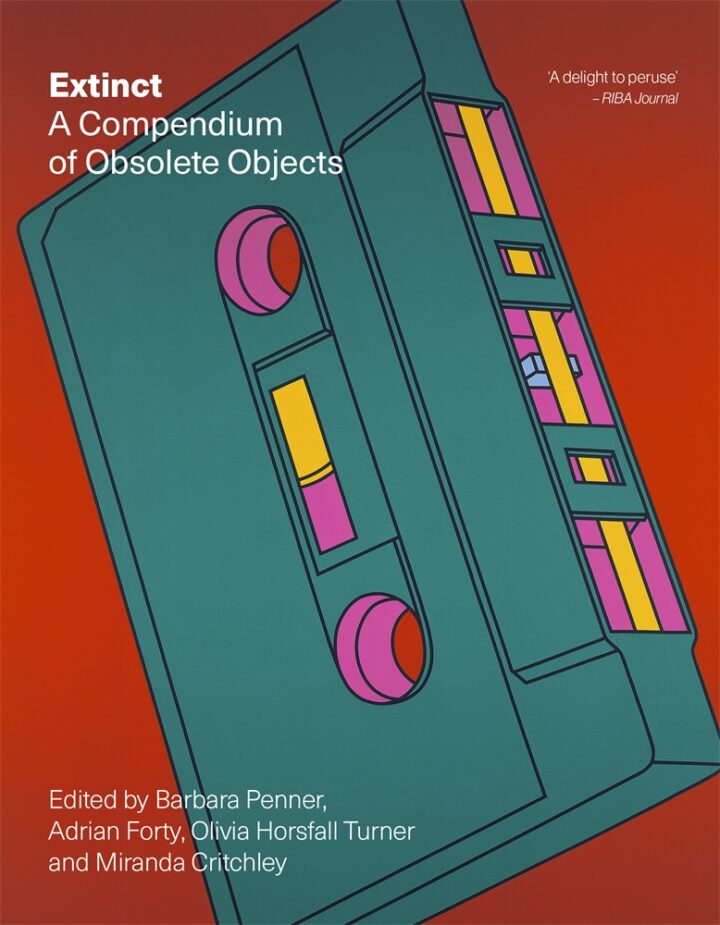
Writing, Schalansky theorizes, is not resurrection, “but it can enable everything to be experienced.” The best essays in Extinct manage this, bringing the ashtray and the tragedy of arsenic wallpaper and the strange floodlights of streets lit by moon towers not quite to life but into the realm of our imagined experience . . . Extinct is also a beautiful object in its own right: hardcover, with a colorful cover illustration of a cassette tape, and rich photographs and drawings that accompany the essays.
'The Baffler
-
'
An innovation that seemed life changing in one era might seem ridiculous or useless – or even deadly – in another. This illustrated cavalcade of inventions highlights the rise (and fall) of such things as the Concorde, arsenic wallpaper, pneumatic tubes, and flying cars.
'MIT Technology Review
-
'
The Clapper, literal snail mail, anti-gravity underwear – there are reasons why all of these objects are extinct. But now, a new book is exhuming them from the trash heap of history. In Extinct: A Compendium of Obsolete Objects, a team of professors, historians, artists, and curators seeks to understand why various objects became 'obsolete,' and what this tells us about the worlds they existed in. Modern technology now moves at a lightning pace, with endless updates to phones, cameras, and other gadgets. But the book's authors hope to challenge the assumption that things disappear due to "inadequacy" or "unsuitedness to their conditions." From the defunct to the superseded, from the failed to the visionary, there can be many reasons why an invention no longer serves a purpose.
'CNN Style
-
'
A fascinating and curious read. It is host to accounts, conclusions, and warnings from the ghosts of deceased inventions and their often-haunting lives that float on beyond the grave. The authors use natural selection and evolution as an analogy to the birth, death, mutation, and rebirth of designed or ideated objects as they cycle through their usefulness and ultimate obsolescence.
'departmentofinformation.org
-
'
A truly fascinating and consistently unexpected account of a forgotten landscape of lost futures. This richly original work chronicles the designed world of the undead and, at the same time, challenges today’s easy consensus of progress and modernisation. Entertaining, jolting, and scholarly it is a superb counter-blast to our own age of relentless upgrades and product improvements.
'Tristram Hunt, Director of the Victoria and Albert Museum, London
-
'
This is a wonderfully curious book about how the ghosts of extinct inventions live on, not just in our minds but in the world around us. It is strangely addictive to discover how the epitaphs of these technologies form the blueprints of our future.
'Mark Miodownik, author of Stuff Matters: The Strange Stories of the Marvellous Materials that Shape Our Man-made World
-
'
Objects have come and gone from our lives throughout history, mostly because something new has been designed to fulfil their functions more efficiently, appealingly, economically or sustainably. Never before has this happened with such speed or on the same scale as in the digital age. Extinct is both a thoughtful and incisive analysis of the phenomenon and an engaging tribute to some of the intriguing or eccentric objects we have lost in design’s equivalent of natural selection.
'Alice Rawsthorn, author of Design as an Attitude
-
'
Extinct is an intoxicating exploration of a host of objects, systems and protocols that are no longer in use or never made it. They are design ghosts, actively haunting the present and conjuring up alternative nested futures. Each short story becomes epic. This brilliant book is a survey of the future rather than of the past.
'Beatriz Colomina, Howard Crosby Butler Professor of the History of Architecture, Princeton University
Introduction
Barbara Penner, Adrian Forty, Olivia Horsfall Turner and Miranda Critchley
Acoustic Location Device
Bryony Quinn
Action Office Acoustic Area Conditioner: The ‘Maskitball’
Kristen Gallerneaux
Air-curtain Roof
Laurent Stalder
All-plastic House
Carola Hein
Arsenic Wallpaper
Lucinda Hawksley
Arundel Print
Tanya Harrod
Asbestos-cement Rondavel
Hannah le Roux
Ashtray
Catherine Slessor
Atmospheric Railway
Niall McLaughlin
Cab-fare Map
Paul Dobraszczyk
Central Heating
Mario Carpo
Chaparral 2j: The ‘Sucker Car’
Eirik A. G. Bøhn
Chatelaine
Iris Moon
The Clapper
Charles Rice
Close-constraint Key
Ben Vandenput
Concorde
Thomas McQuillan
ConvAirCar
Emily M. Orr
Cybernetic Anthropomorphic Machines
Lydia Kallipoliti
Cybersyn
Hugo Palmarola and Pedro Ignacio Alonso
Cyclegraph
Barbara Penner
Cyclops 1
Thandi Loewenson
Dougong
Guang Yu Ren and Edward Denison
Dymaxion House
Barry Bergdoll
Edison’s Anti-gravitation Under-clothing
Ben Nicholson
Electrotype Pattern
Angus Patterson
Fisher-Price Peg Figures
Mark Morris
Flashcube
Harriet Harriss
Flying Boat
David Edgerton
Glass Lantern Slide
Daniel M. Abramson
Globe of Mars
Lucy Garrett
High-pressure Water Mains
Adrian Forty
House Environment
Eszter Steierhoffer
‘Hummingbird’ Taxi
Lucinda Hawksley
Incandescent Light Bulb
Mari Hvattum
Integrated Radio/TV Cabinet
Anders V. Munch
Invacar: The ‘Invalid Carriage’
Elizabeth Guffey
Kodachrome
Tacita Dean
Letraset
Robin Kinross
Leucotome
Carsten Timmermann
Manchester Pail System: ‘Dolly Vardens’
Barbara Penner
Mechanical Polygraph
Danielle S. Willkens
Medical Wax Model
Thomas Kador
Memo
Adrian Forty
Milk Spoon
Hugo Palmarola
MiniDisc
Priya Khanchandani
Minitel
Shahed Saleem
Moon Towers
Bryony Quinn
Nikini
Rachel Siobhán Tyler
‘No Nonsense’ Fountain Pen
Pippo Ciorra
North Bucks Monorail City
Gillian Darley
Notgeld
Tom Wilkinson
Oil from Coal
David Edgerton
Optical Telegraph
David Trotter
Paper Aeroplane Ticket
Gökçe Günel
Paper Dress
Olivia Horsfall Turner
Pasilalinic-sympathetic Compass
Richard Taws
Phase-change Chemical Heat-storage Barrel
Daniel Barber
Player Piano
Hal Foster
Pneumatic Postal System
Jacob Paskins
Polaroid SX-70
Deyan Sudjic
Public Standards of Length
David Rooney
Pyrophone
Tim Boon
Realistic Wax Mannequin
Maude Bass-Krueger
Rotring, Letratone, MiniCAD
Tony Fretton
Scaphander: ‘Man-boat’
Steven Connor
Scarificator
Thomas Kador
Serving Hatch
Tim Ainsworth Anstey
Sinclair C5
Simon Sadler
Skirt Grip
Amy de la Haye
Slide Rule
Adrian Forty
Slotted Screwdriver
Richard Wentworth
Space Frame
Catherine Slessor
Stanley 55 Combination Plane
Nikos Magouliotis
Telephone Table
Edwin Heathcote
Teletype
James Purdon
Théâtrophone
Carlotta Darò
Think City Electric Vehicle
Kjetil Fallan
Trombe Wall
Paul Bouet
T-shirt Plastic Bag
Johanna Agerman Ross
Ultratemp® Roasting Rack
Christian Parreno
UV-radiated Artificial Beach
Maarten Liefooghe
Vertical Filing Cabinet
Zeynep Çelik Alexander
Water Bag
Sarah Bell
Writing Case
Barry Curtis
Zeppelin
Jeremy Myerson
Biographies
References and Further Reading
Acknowledgements
Photo Acknowledgements
Barbara Penner (Anthology Editor)
Barbara Penner is Professor in Architectural Humanities at the Bartlett School of Architecture, UCL. Her books include Bathroom (Reaktion, 2013) and she is a contributing editor of Places Journal.
Adrian Forty (Anthology Editor)
Adrian Forty is Professor Emeritus of Architectural History at the Bartlett School of Architecture, UCL. He is the author of many books including Concrete and Culture: A Material History (Reaktion, 2012).
Olivia Horsfall Turner (Anthology Editor)
Olivia Horsfall Turner is Chief Curator of the Royal Institute of British Architects (RIBA) Collections.
Miranda Critchley (Anthology Editor)
Miranda Critchley completed her PhD on railways and colonial narratives of progress in 2022 at the Bartlett School of Architecture, UCL. She now works as a solicitor specialising in public law and migrants’ rights.